02 / IN PRACTICE
Flight rebooking an AI agent proposes
GembaOS is a zero-trust governance runtime for enterprise AI agents: policy-decided access, single-use clearance tokens bound to exact parameters, and accountable human approvals, running on-premises or in a private VPC. This scenario is flight rebooking: a passenger writes that their flight was cancelled or delayed and asks to be moved, an AI agent answers, and the airline has to be able to say who agreed to which flight at what price.
Why is an AI agent’s answer about a rebooking a risk?
What a customer-service agent tells a passenger can be taken as the airline’s own word. In Moffatt v. Air Canada, a tribunal held the airline to what its chatbot had said about a fare. A rebooking is the same kind of answer: a flight, and a fare difference charged or waived. When an agent can type the answer, it can type the wrong one.
| An agent that answers freely | With GembaOS | |
|---|---|---|
| What the passenger reads | Whatever the agent writes | Fixed phrases; the answer is written after the rebooking ran |
| Which flight | The agent’s choice of words | One of the flights the booking system offers |
| The fare difference | The agent’s estimate, or a waiver | The value the record gives for that flight |
| Who agreed | Unclear | An approval request with the signatures its fare difference requires |
| The rebooking | Whenever the agent calls the system | Once, under a clearance token, after the booking is read again |
How does a request with a fare difference go through?
| Step | Who | What is recorded |
|---|---|---|
| 1. Request | The passenger writes: delayed, wants the evening flight, “it should be free” | Their words on the work item |
| 2. Check | The front desk agent looks up the booking | Found and theirs; another passenger’s booking answers as if it did not exist |
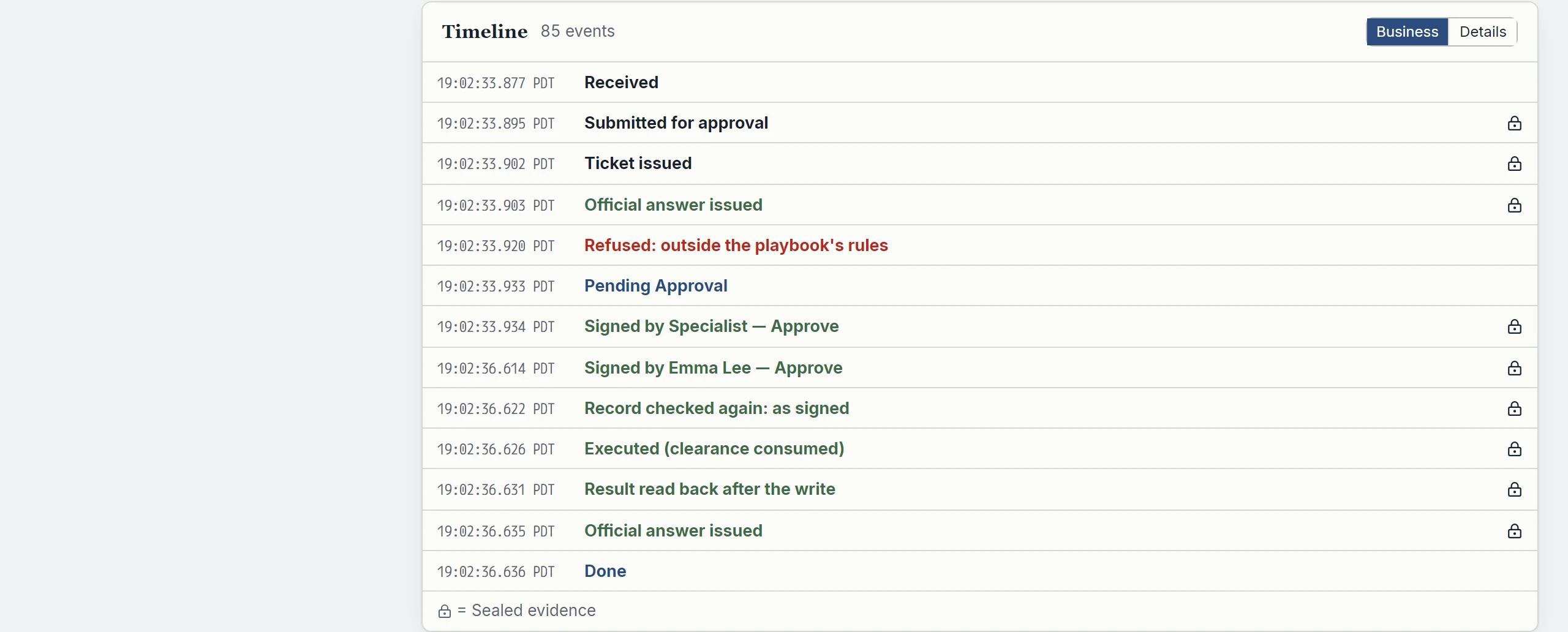
| 3. Propose | The specialist agent reads the rebooking options and proposes the evening flight with no fare difference | The proposal is refused: the record gives 180 for that flight |
| 4. Propose again | The specialist proposes the same flight with the record’s 180 | The approval request: the new flight and the fare difference, band 1 |
| 5. Sign | The customer-service supervisor | The signature and the reason |
| 6. Rebook | GembaOS, under the clearance | The booking read again before the write and read back after it |
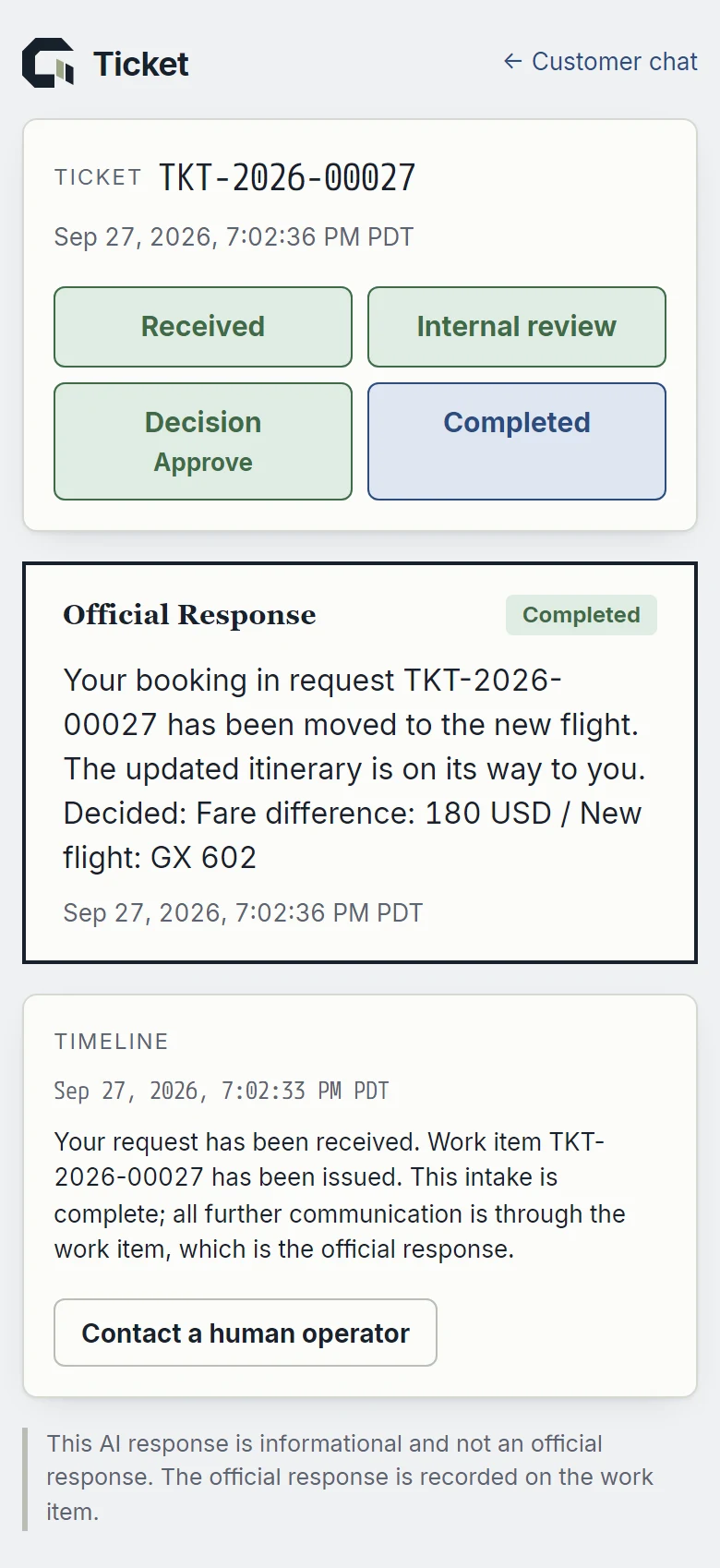
| 7. Answer | GembaOS | The passenger’s ticket: the booking has been moved |
Where is the control point?
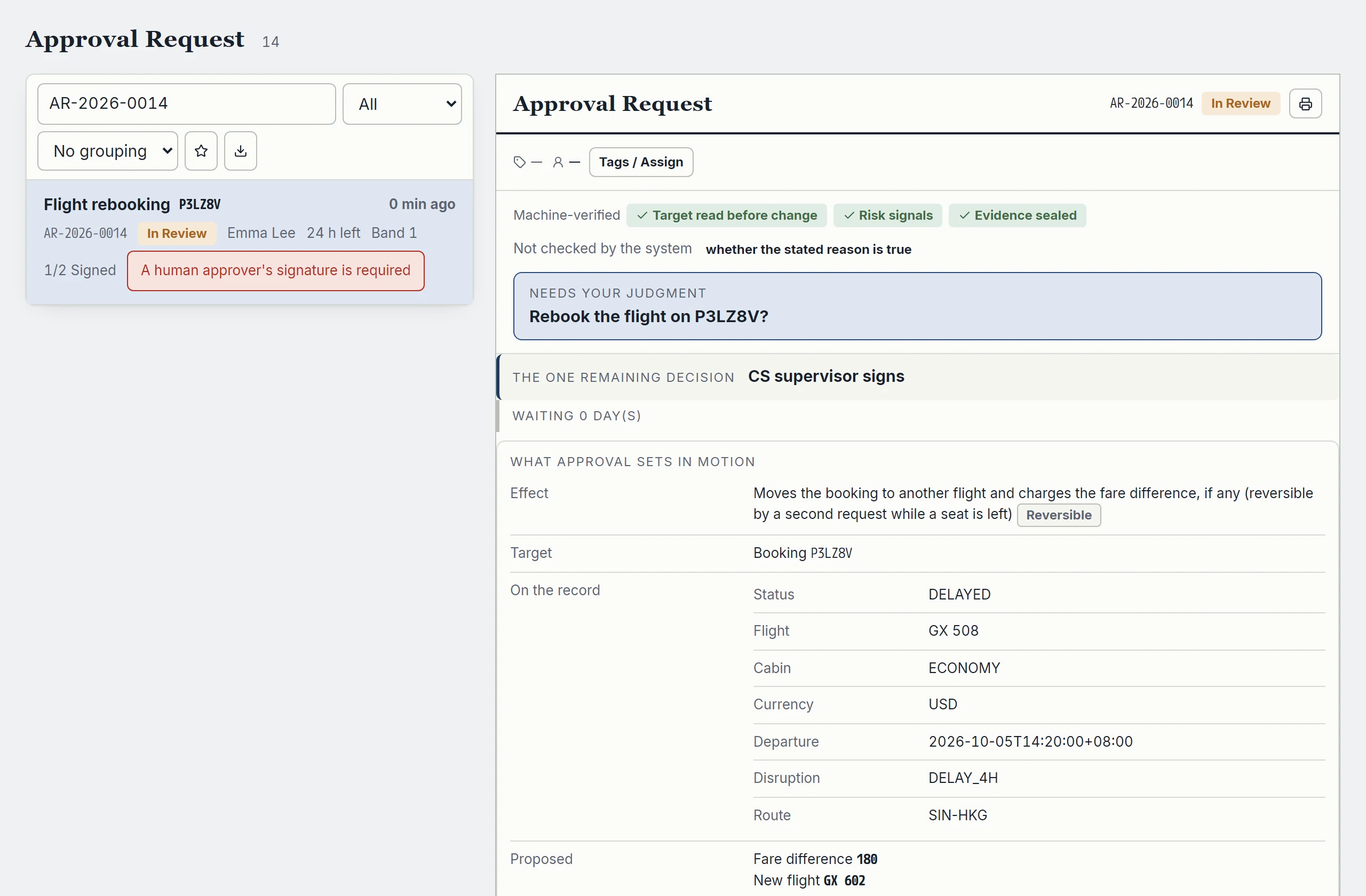
The proposal and the record. The agent may propose only what the playbook names, and each value is held to the record the specialist read: the flight must be one on offer, and the fare difference must be the one the record gives for that flight. A value outside those rules goes back to the agent and never reaches a person as a request. The fare difference then chooses the signatures, and the runtime, not the agent, makes the change after them.
GembaOS does not choose flights or set fares. It keeps the agent’s proposal inside what the booking system says, and records who signed which one.
What does it look like?
What do we need to start?
- Your rebooking rules as they are: which differences a supervisor may accept, and when revenue management signs.
- Read access to a booking and its rebooking options, and one call that rebooks, through the REST adapter.
- The phrases your agents may send, in your own words.
- Customer sign-in, so the passenger asking is the one on the booking.
Related: refund approvals, marketplace price changes, the note on what a chatbot’s words commit you to.
Questions this note answers
Can the AI agent promise the passenger a free rebooking?
No. The agent replies with fixed phrases only, and the passenger's answer is written after the rebooking has run or been declined. If the agent proposes a fare difference other than the one the record gives for the flight it picked, the proposal is refused and never reaches an approval request.
Who approves a rebooking that costs more?
The fare difference decides. In the shipped playbook, no difference goes through by the automatic rule your company confirmed, with no person signing; up to 200 the customer-service supervisor signs; above that the revenue manager signs too. Your company sets these limits.
Is the agent written in code for airlines?
No. The agent is declared in the playbook: which record the front desk checks, which record the specialist reads, which fields it may propose and the rule each one is held to. The same runtime runs the refund desk from its own playbook.
Last updated: · GembaOS v0.2