02 / IN PRACTICE
Keep your CRM, add the decision record
GembaOS is a zero-trust governance runtime for enterprise AI agents: policy-decided access, single-use clearance tokens bound to exact parameters, and accountable human approvals, running on-premises or in a private VPC. This scenario is the existing-CRM case: the CRM stays the system of record for accounts and cases, and GembaOS holds the decision record for what happens beyond it.
How do we keep our CRM and its agent, and still own the decision?
GembaOS leaves the CRM as the system of record and puts itself only where an action leaves the CRM: it reads the case under field-level rules through the capability gateway, composes the cross-system action, routes it by policy, and after the signature executes it once under a clearance token. The decision goes back to the case timeline as a comment, so the CRM shows what happened and GembaOS shows who decided and why.
| Before | With GembaOS | |
|---|---|---|
| Routine closure | The CRM agent closes the case | Still passes, on the agent stamps, and is recorded |
| Escalated or legal-hold case | Closed by whoever has the button | Stops at the CS supervisor, who signs with a passkey outside the vendor |
| The action beyond the CRM | A refund or credit note with no accountable owner | Executed once, under a clearance bound to this case and this reason |
| The record | Lives with the vendor, in the vendor’s format | The signature chain and the replayable decision live with you; the CRM gets a comment |
What happens, step by step?
| Step | Who | What is recorded |
|---|---|---|
| 1. Case event | The CRM or its agent calls GembaOS | The event and its external reference |
| 2. Pre-read | The host reads the case, trimmed to the fields the specialist may see | The facts on the request |
| 3. Route | The policy: routine passes, escalated or legal hold needs a person | The route and the rule chain |
| 4. Sign | The CS supervisor with a passkey | The signature chain |
| 5. Execute | The host re-reads the case, compares, then closes it once under the clearance | The precondition check and the execution |
| 6. Mirror | The decision is written back to the case as a comment | The external reference of the comment |
Where is the control point?
The control point is the route decision on the pre-read facts, and the human signature for the cases the policy reserves. The CRM agent, the vendor’s own or yours, can call the same gateway the same way; what it cannot do is close an escalated case or move money on its own authority. The same pack serves several CRM wire shapes; the field names and the id formats are the only parts that change between vendors.
What does it look like in the console?
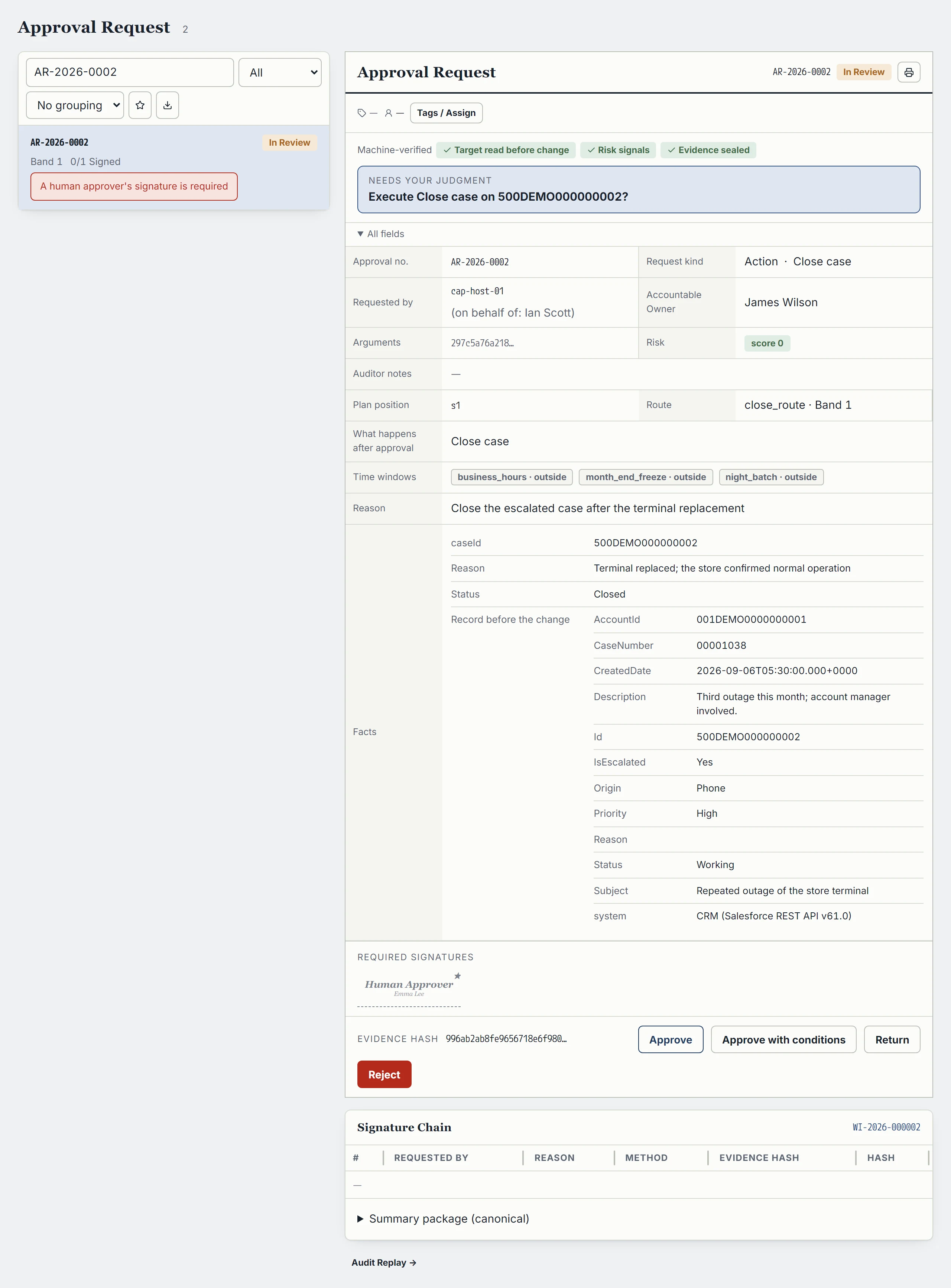
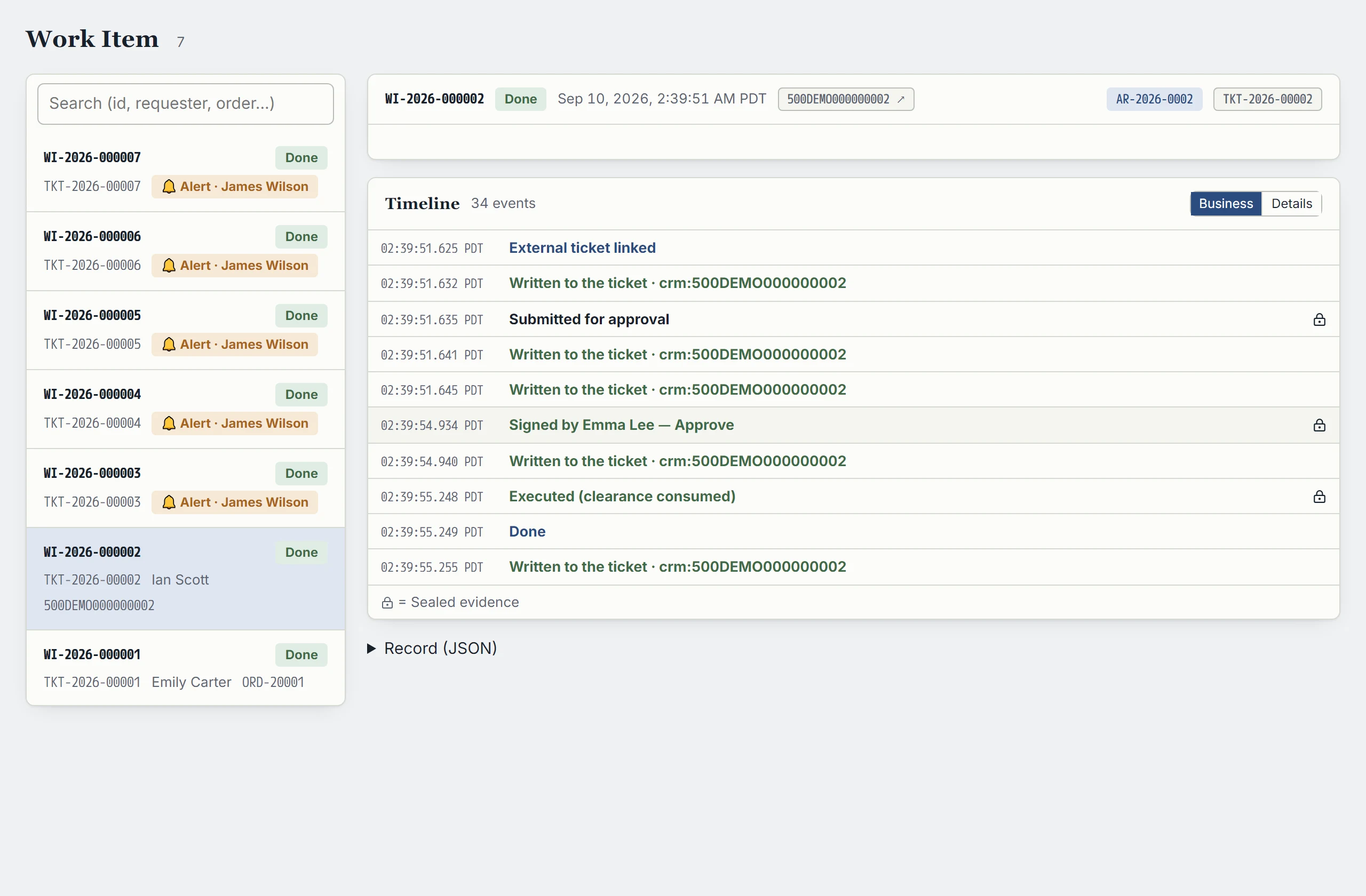
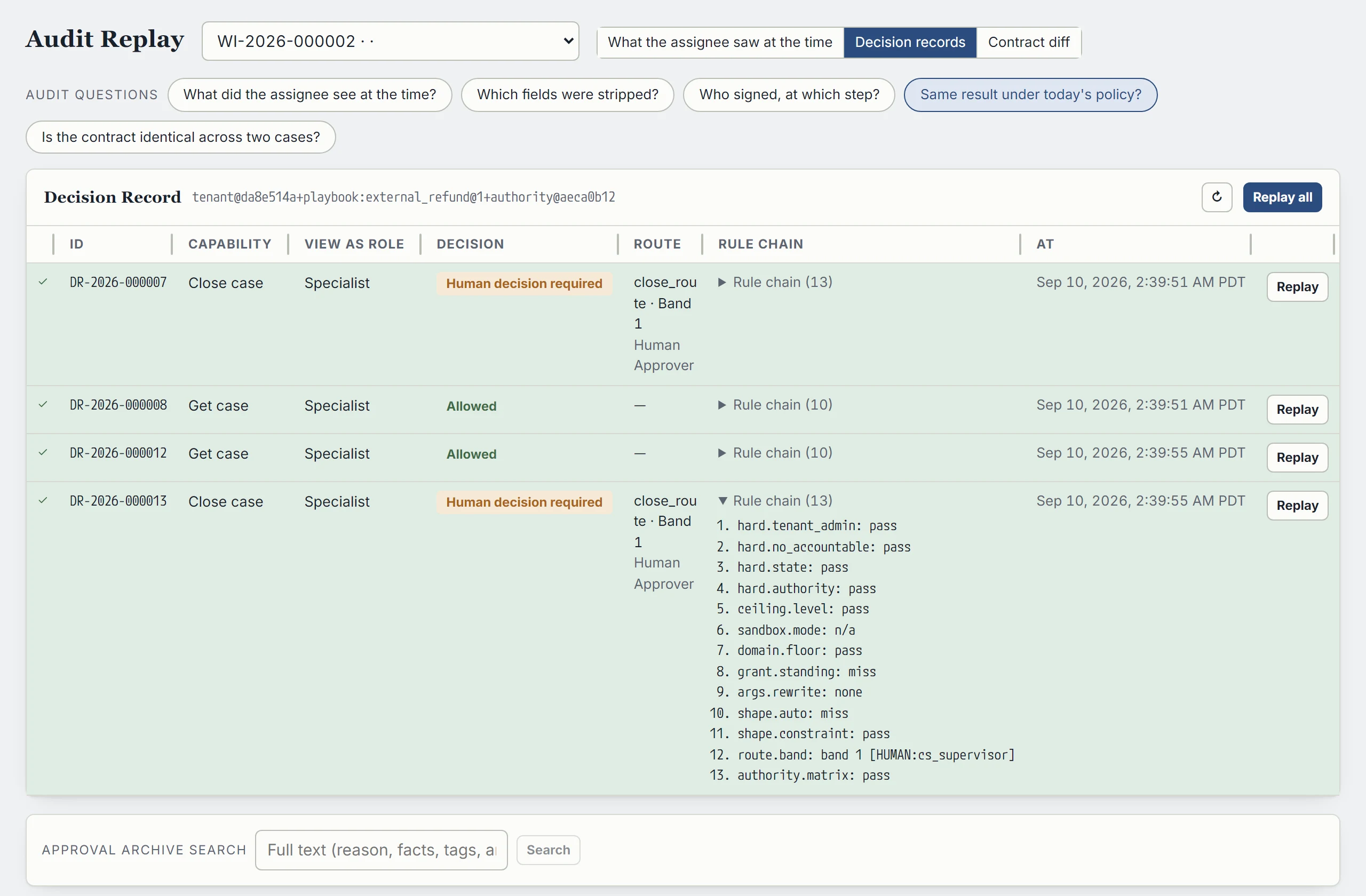
What do we need to start?
- API access to the CRM for reading cases and writing comments, with the credential held at the gateway.
- The field-level rule: which case fields a support specialist may see.
- The escalation and legal-hold rule as it stands: which cases need a person, and who.
- If the CRM’s own agent will call GembaOS, its MCP or tool-call interface.
Related: refunds and claims, security and deployment, the FAQ.
Last updated: · GembaOS v0.2