02 / IN PRACTICE
Cross-team work with responsibility attached
GembaOS is a zero-trust governance runtime for enterprise AI agents: policy-decided access, single-use clearance tokens bound to exact parameters, and accountable human approvals, running on-premises or in a private VPC. This scenario is the cross-team case: a list arrives from one department, another department’s agent acts on it, and the question is who is accountable for each row.
How does work move between teams and agents without losing the owner?
GembaOS keeps one persistent work item for the whole workflow and routes every transition through the policy, so that each specialist agent receives only the context its role may see and each decision lands with the human owner named for that step. A list of many rows becomes one aggregated approval request; the owner signs once; every row executes under its own clearance token.
| Before | With GembaOS | |
|---|---|---|
| The hand-over | An email with a spreadsheet, forwarded twice | A work item that carries the list, its source and every transition |
| Context | Every agent sees everything | Separation of duties: each role sees its fields, nothing more |
| The decision | “Please process” from whoever forwarded it | One signature by the designated owner, on the facts as they stand before the change |
| A typo in the list | The whole batch fails, or the wrong account is touched | That row fails alone and is reported; the other rows go through |
What happens, step by step?
| Step | Who | What is recorded |
|---|---|---|
| 1. Intake | HR hands over the month-end leavers; the batch page parses the rows | The list as it came, and how it was read |
| 2. Pre-read | The host reads each account as it stands | The facts per row; an unreadable row shows as such |
| 3. Aggregate | One approval request with every row | The request the owner will see |
| 4. Sign | The IT administrator, once, with a passkey | The signature chain |
| 5. Clearances | One per row, each bound to its own arguments | Four clearances for four accounts |
| 6. Execute | Row by row; a failure stops only its own row | Each execution and its outcome |
Where is the control point?
The control point is the single signature on the aggregated request, taken on the pre-read facts. Nothing in the list can widen what the signature covers: a row that was not on the request has no clearance, and a row whose account changed since the pre-read is returned rather than executed. The Gap Register collects what the process lacked, such as a missing hand-over rule, for the owner to fill in later.
What does it look like in the console?
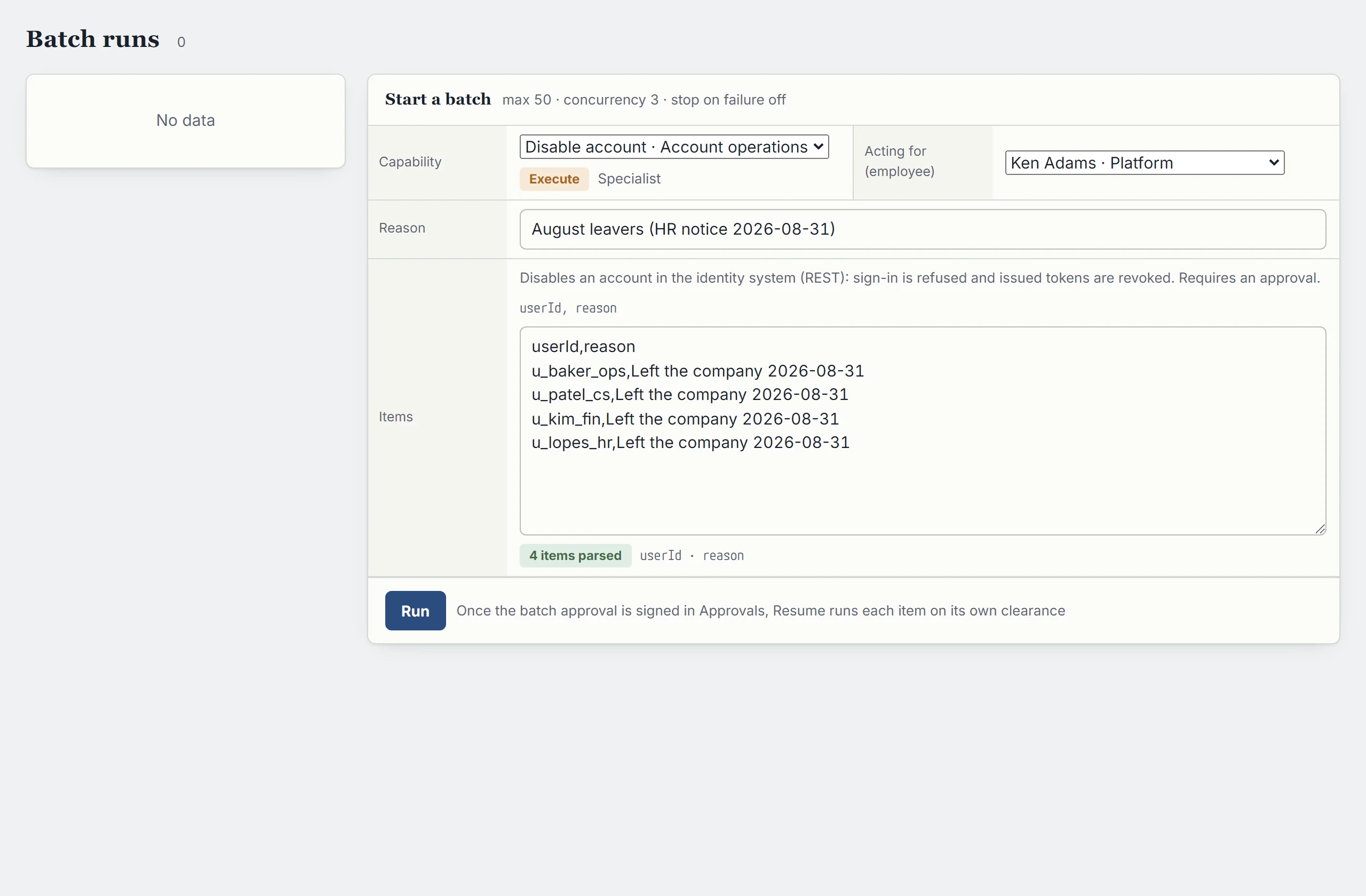
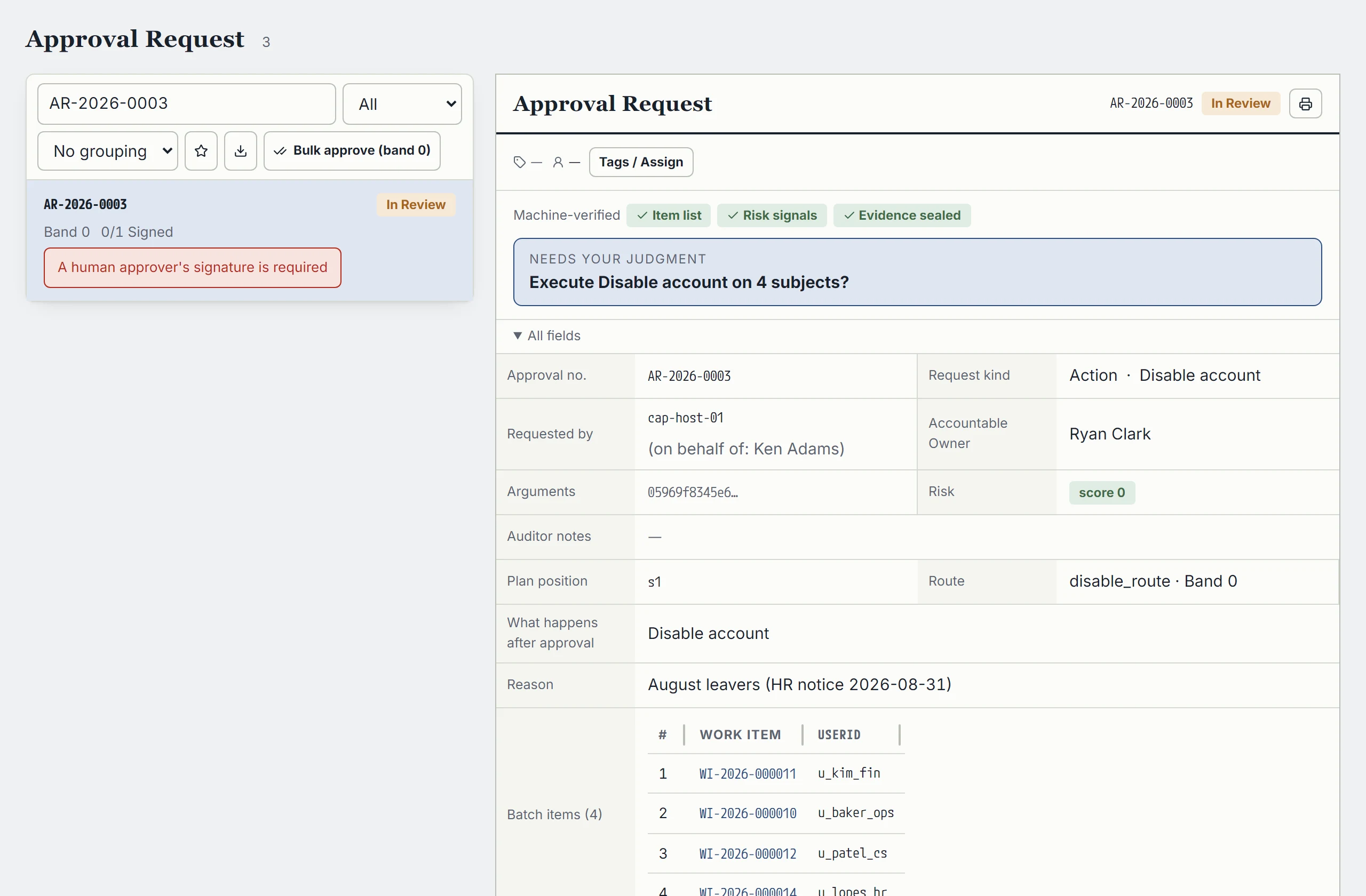
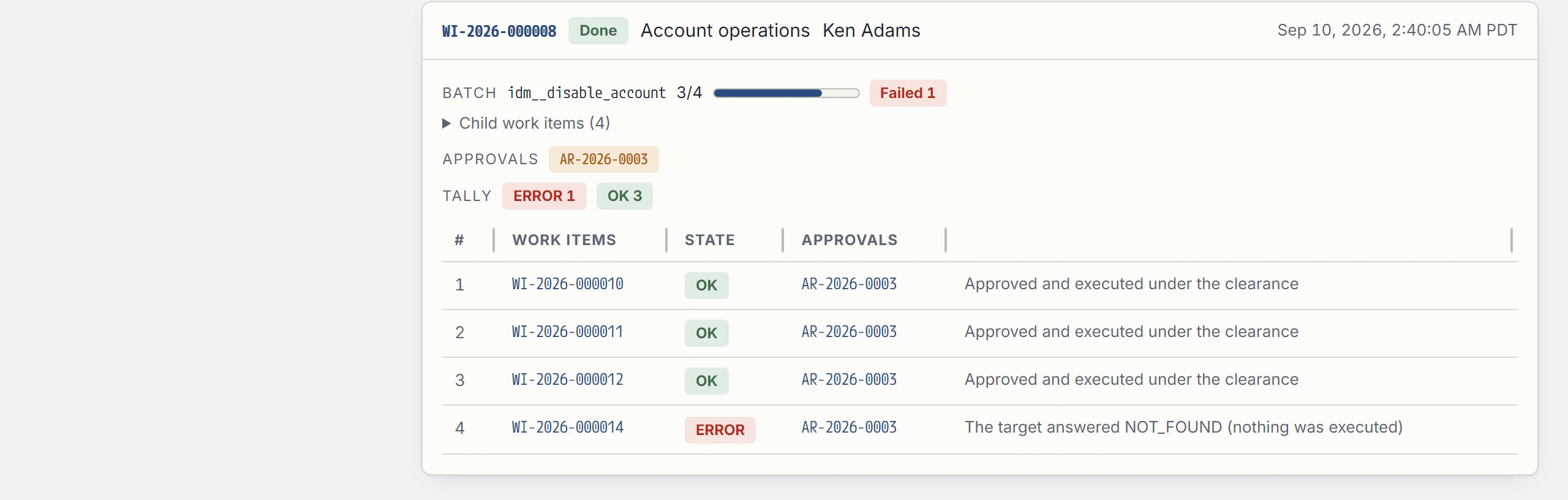
What do we need to start?
- The hand-over as it happens today: the list format, who sends it, who acts on it.
- The identity or account system the rows touch, through the REST, SQL or worker adapter.
- The owner who signs for that class of change, from your authority table.
- Optionally, a ticket system to mirror each batch into, so the record appears where the team already looks.
Related: production changes, design partner program, the glossary.
Last updated: · GembaOS v0.2