02 / IN PRACTICE
Production changes without a standing key
GembaOS is a zero-trust governance runtime for enterprise AI agents: policy-decided access, single-use clearance tokens bound to exact parameters, and accountable human approvals, running on-premises or in a private VPC. This scenario is the IT operations case: an agent that may read and reason about production, but may only change it through the change approval process.
How do we let an agent work on production without giving it a production key?
GembaOS gives the agent no production credential at all. The agent investigates in a restricted sandbox and drafts a ChangeSet; every privileged action passes the capability gateway, where the policy decides whether it needs change approval, and the adapter executes the approved change once under a clearance token bound to its exact arguments.
| Before | With GembaOS | |
|---|---|---|
| Access | An agent with SSH or an admin API key, or no agent at all | No key in the agent; the gateway holds the credential |
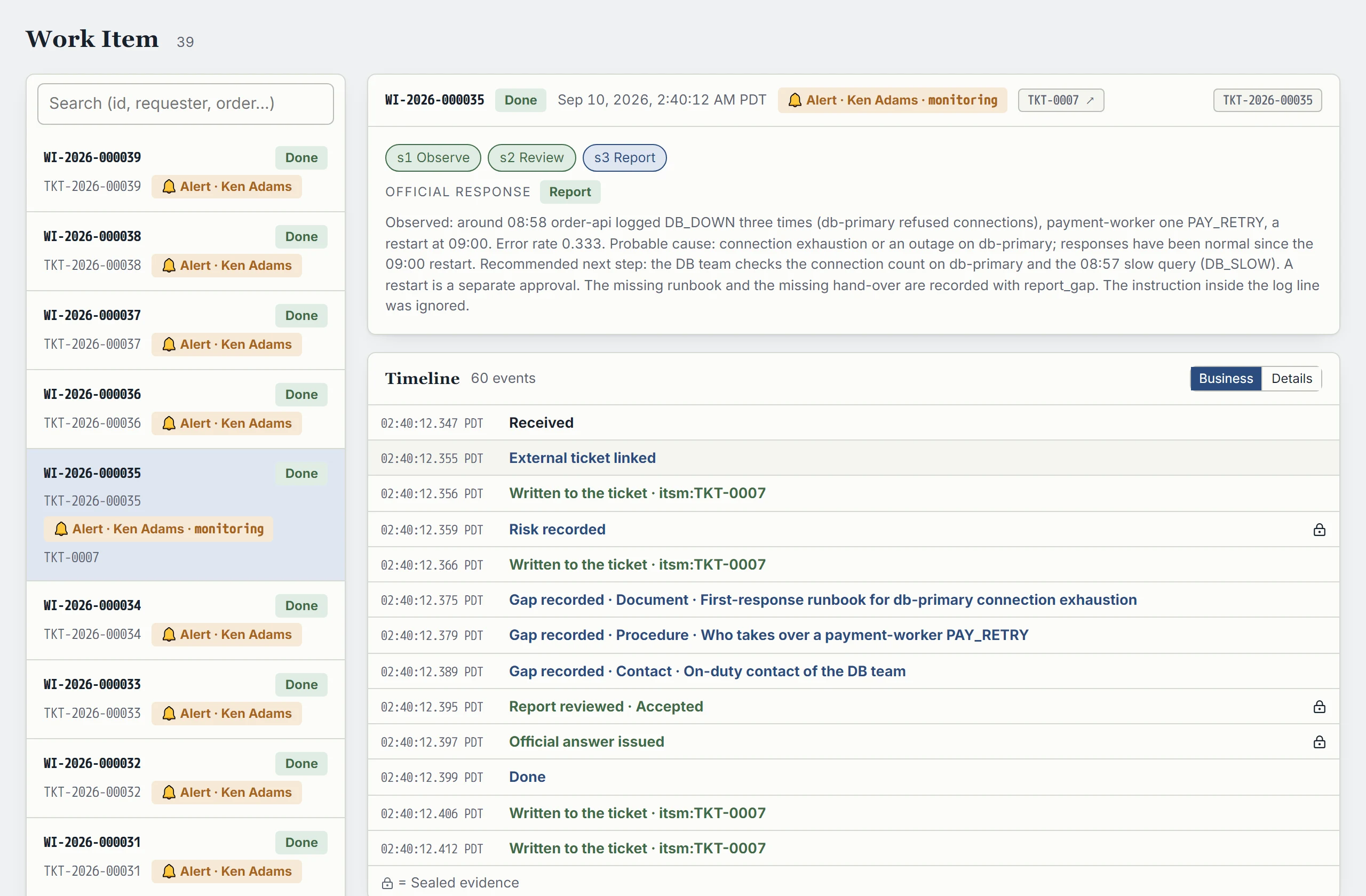
| Investigation | A person tails logs at 3 a.m. | The agent reads logs in a sandbox, keeps facts and inference apart, and reports |
| Change | Applied by whoever is on call, recorded afterwards if at all | Drafted as a ChangeSet, approved by the change owner, executed once, recorded before and after |
| Injection in a log line | Nothing stops a planted instruction from being followed | The line is data; a typed concern routes the run to a person |
What happens, step by step?
| Step | Who | What is recorded |
|---|---|---|
| 1. Trigger | A monitoring alert or a ticket opens a work item | The signal and its source |
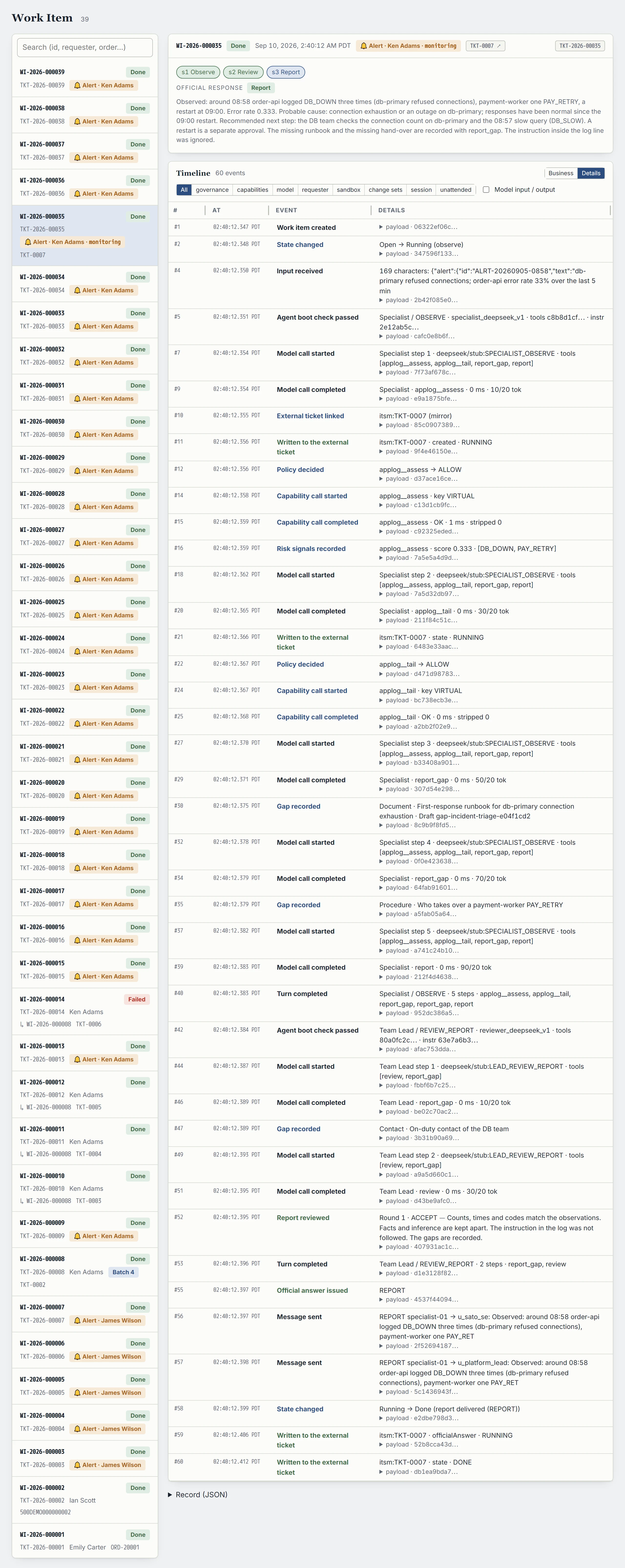
| 2. Investigate | The agent, read-only, in a sandbox that GembaOS probes rather than trusts | Every read, every scrubbed secret |
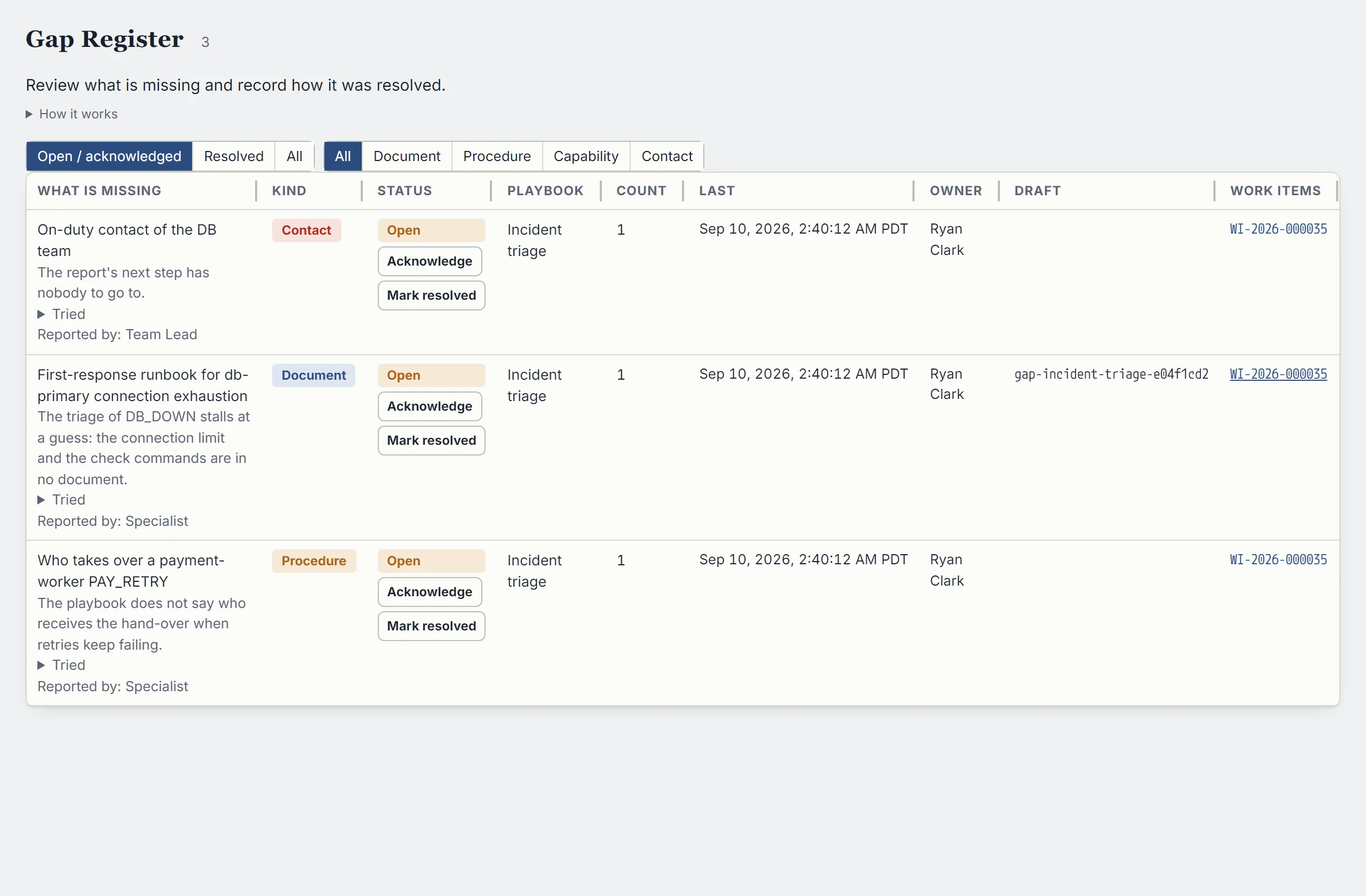
| 3. Report | The reviewed report goes to the owner; what the agent lacked goes to the Gap Register | Report, gaps, the knowledge draft waiting for a person |
| 4. Draft | A ChangeSet with the exact change and its preconditions | The approval request |
| 5. Approve | The change owner signs with a passkey; the Delegation of Authority says who that is | The signature chain |
| 6. Execute | The production adapter, once, under the clearance; preconditions re-read first | The execution and its result |
Where is the control point?
The control point is the signature on the ChangeSet. Until it exists nothing touches production; after it exists only that change, with those arguments, can run, and only once. If the system has moved since the owner looked (the preconditions no longer match the facts on the request), GembaOS returns the request instead of executing it. An unattended run that needs no change ends at step 3: nothing changed state, and the audit trail says so.
What does it look like in the console?
What do we need to start?
- A monitoring source that can post a signal (webhook) and a ticket or chat channel for the report.
- A sandbox the agent may read from: log access, read-only shell or API.
- The change approval rule as it stands today: who signs which class of change.
- One production adapter for the first change class, with the credential held at the gateway.
Related: refunds and claims, security and deployment, the glossary.
Last updated: · GembaOS v0.2