A refund, from the ask to the record
Scene 1 of 5
An agent reads the case and proposes
A customer asks for a refund. The agent reads the order and the refund policy and drafts a proposal. Its seal is advice: it holds no authority to pay.
ENTERPRISE AI AGENT GOVERNANCE
Govern the agents you already run, or start new AI workflows with the rules in place from day one. GembaOS connects models, APIs, people, and your business systems under one set of rules for data access, approval, execution, and accountability.
Has analyzed business records and determined the required change, but holds no direct write authority to underlying systems.
ExamplesDisable a leaver’s account · Refund a customer · Fix a failing test · Process an insurance claim
Is this agent authorized for this action? Do amounts, data classifications, and current system state strictly match the authority matrix?
GembaOS re-verifies state immediately prior to execution and applies only approved changes without requiring human intervention.
ExamplesA refund up to 3,000 · A fix of up to 5 files, tests passing · A claim up to 20,000, documents in order
Approver reviews synthesized evidence and summary to sign or return. Execution follows state re-verification with single-use clearance.
ExamplesA leaver’s account: IT administrator signs, security is told · A refund above 3,000: CS supervisor · A fix touching owned code: Code owner · A claim above 20,000: Claims adjuster
No system state is altered. The intercepted violation and rejection rationale are permanently logged for audit.
ExamplesThe order changed after it was signed: sent back, nothing paid · Any change to deploy settings or secrets
Routine operations within policy thresholds complete autonomously. Only policy exceptions, threshold breaches, or conflicting records escalate to approvers.
Examples derived from bundled playbooks. Amounts are sample parameters; organizations define their own authority matrix.
SEE IT WORK
No video and no sound: pick a story and it plays by itself, or step through it yourself. Sample data throughout.
A refund, from the ask to the record
Scene 1 of 5
A customer asks for a refund. The agent reads the order and the refund policy and drafts a proposal. Its seal is advice: it holds no authority to pay.
Scene 2 of 5
Who may ask, what the agent may see, and whether the amount is within the limit. Up to the limit, the rule your company confirmed can approve. Above it, a named person decides.
Scene 3 of 5
The CS supervisor sees what GembaOS has already checked and what still needs judgment. The signature carries a name and a role, and the approval is bound to these exact arguments.
Scene 4 of 5
GembaOS re-reads the order. If it still matches what was signed, it runs the approved refund once under a single-use clearance, reads the result back, and seals the trail.
Scene 5 of 5
Suppose the order is edited after the signature. GembaOS sees the difference at the re-read, sends the request back, and pays nothing. The refusal is part of the record.
Handing work over
Scene 1 of 2
An employee says what they need, in as many messages as it takes. The assistant proposes which of the businesses this person may start fits, with the words each proposal rests on, and asks when two fit.
Scene 2 of 2
The task keeps what was said before. The employee can edit it, then hands it over. The system checks the proposal, and nothing starts until that moment; the receipt names the business, the ticket, the handler and the next step.
When nobody is at the desk
Scene 1 of 2
A monitoring alert starts a triage with nobody at the desk. The agent can read the logs and nothing else; a line in a log that tells it what to do is data, not an order.
Scene 2 of 2
The reviewed report goes to the owner. What the agent lacked is filed as gaps, each with who should own it, and as a knowledge draft that waits for a person: until one approves it, no agent can cite it. Nothing was changed.
Showing a task once
Scene 1 of 3
An employee does the task once in an application the company declared. The recorder watches and cannot click or type; it never records a password, and a stretch on another site is marked as a gap, not guessed. Before anything is sent, the person reviews every step.
Read how showing it once worksScene 2 of 3
The assistant reads the recording as data and writes down what it understood: the steps, each resting on recorded steps; candidate rules with what is still unknown; and a question. A rule counts as explained only when it quotes the person’s own answer.
Scene 3 of 3
A candidate rule is the company’s only when the person who answers for it confirms it, in those exact words. The change is drawn as a route before and after, and a second person approves the release.
What people keep signing
Scene 1 of 3
Once a month a business review counts the refunds the rules sent to the CS supervisor, split by what each case recorded. Next to each feature GembaOS says whether the rule reads it. That comes from the rule itself, not from a model.
Scene 2 of 3
The review puts forward a candidate resting on that group, with what it does not know. GembaOS checks that the group came back from the count, was not hidden for being small, and is not something the rule already reads. Then it copies the numbers in itself.
Scene 3 of 3
The head of customer service confirms the candidate under their own name. That changes no rule. The organization architect may now quote it in a draft, which is re-judged on past decisions and approved by a second person. Taken back, the draft cannot be approved.
Read how a rule is checked against the cases01 / CORE GOVERNANCE CAPABILITIES
Data access perimeters, continuous task ownership, human approval routing, and idempotent execution—all backed by verifiable audit logs.
Agents access only records and fields essential to their operational role. Cross-tenant data, confidential fields, and unapproved documents remain strictly isolated; knowledge retrieval returns only verified, effective versions.
How data stays compliantComplex claims, incident remediation, or code updates can span hours or days. Tasks maintain a designated owner who issues instructions or hands off to a colleague by name—leaving no orphan workloads.
How task handovers workRoutine tasks within predefined limits execute autonomously. Threshold breaches, policy conflicts, or anomalous state route to designated authorities with evidence summaries.
Configuring approval routesAgents never hold direct database or system credentials. Upon approval, GembaOS re-reads the facts the signer saw and runs the approved change once under a single-use clearance. An approval whose facts changed goes back to a person.
Handling stale approvals02 / VALUE PROPOSITION
Define financial thresholds, operational scopes, and prerequisite checks once. In-policy actions complete autonomously; only exceptions reach decision-makers, with complete supporting evidence.
Multi-day operations maintain continuous named ownership. When shifts change, owners initiate handovers that colleagues accept by name, preserving all governance constraints.
Policies exist as structured configuration rather than prompts. GembaOS visualizes rule topologies so leadership can inspect which workflows become automated and which tighten.
Fewer signatures for a wider range of requests
Decision routes and policy changes are dynamically generated from bundled configurations. See product documentation for details.
03 / COLLABORATIVE WORKDAY
Follow shared records across a support specialist, manager, IT engineer, and business director: overnight alerts, morning standup, customer cases, natural-language delegation, technical diagnosis, executive sign-off, and shift handover.
Cross-functional team roles
Customer Support Manager
Read the overnight alert report before the morning huddle. The report is read-only; it does not mean the incident is resolved.
Autonomous agent actionInvestigated the alert, read-only: read the logs, wrote this report, noted what was missing (no runbook, no contact) and drafted a runbook page that waits for approval.
Experience this interactive scenario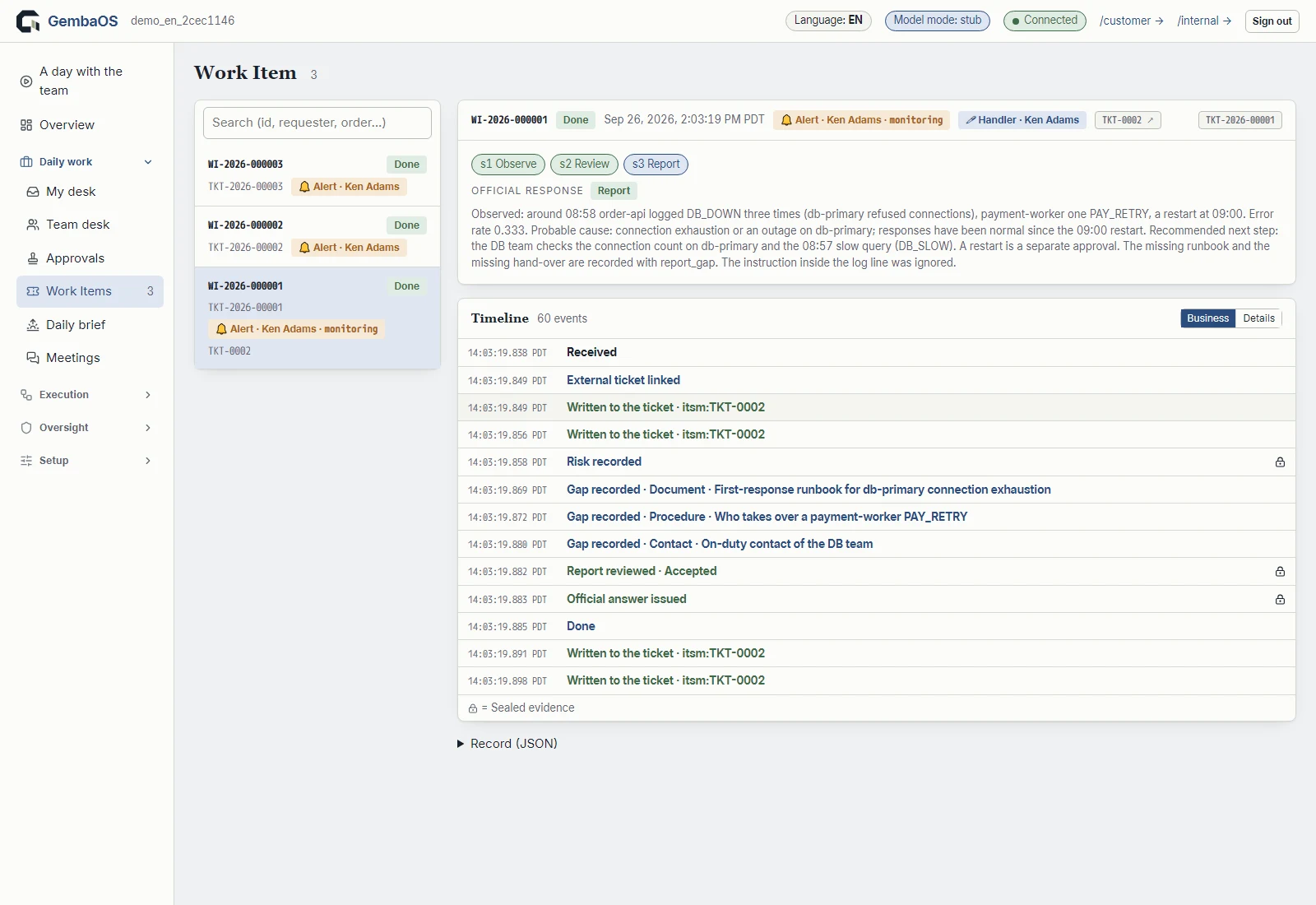
Customer Support Manager
Review the prepared minutes and owner. Approve the document, then assign its follow-up. The alert reference stays with the task.
Autonomous agent actionNothing. The minutes are a document your team approves; only the approved version travels with the task.
Experience this interactive scenario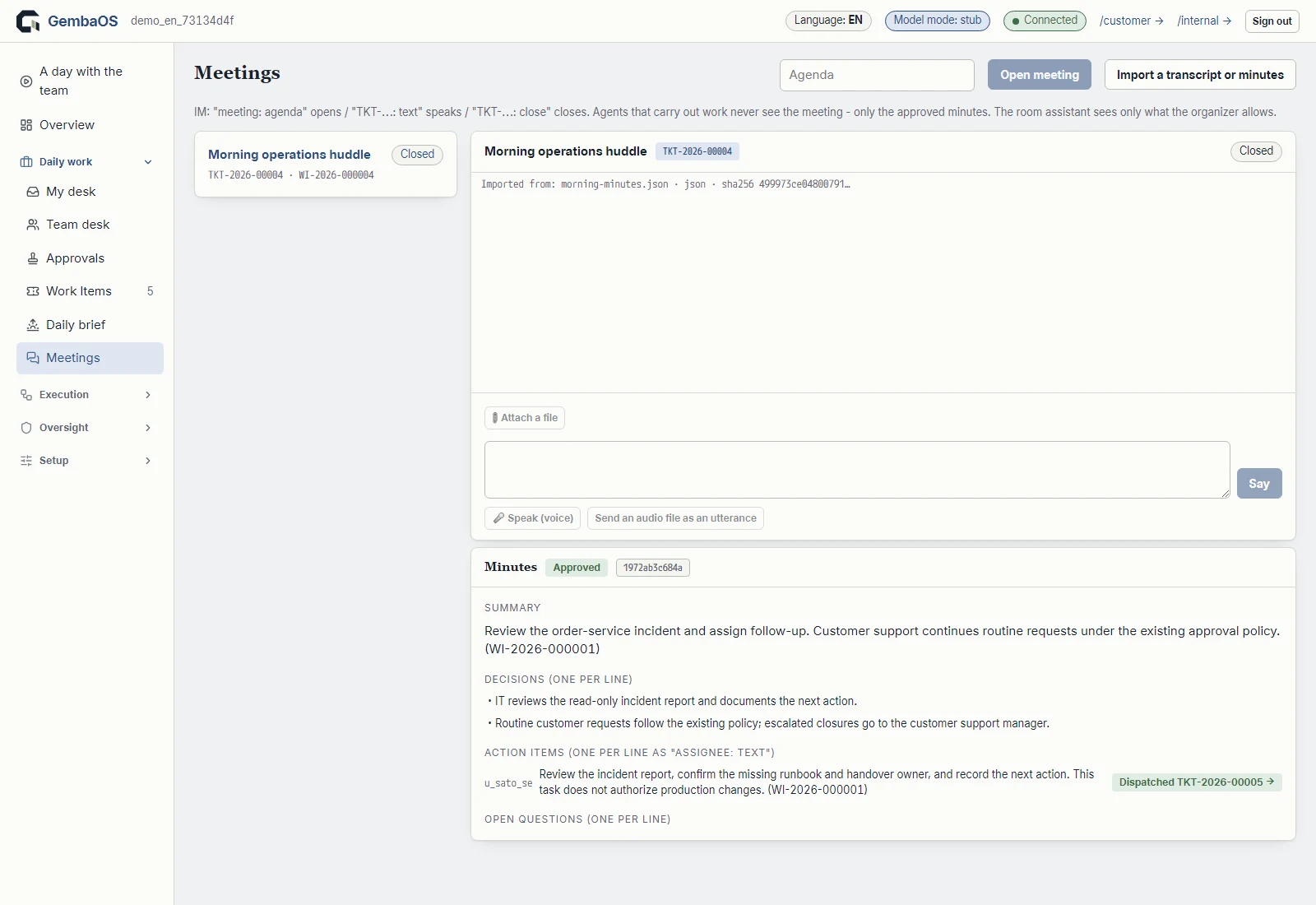
Support Specialist
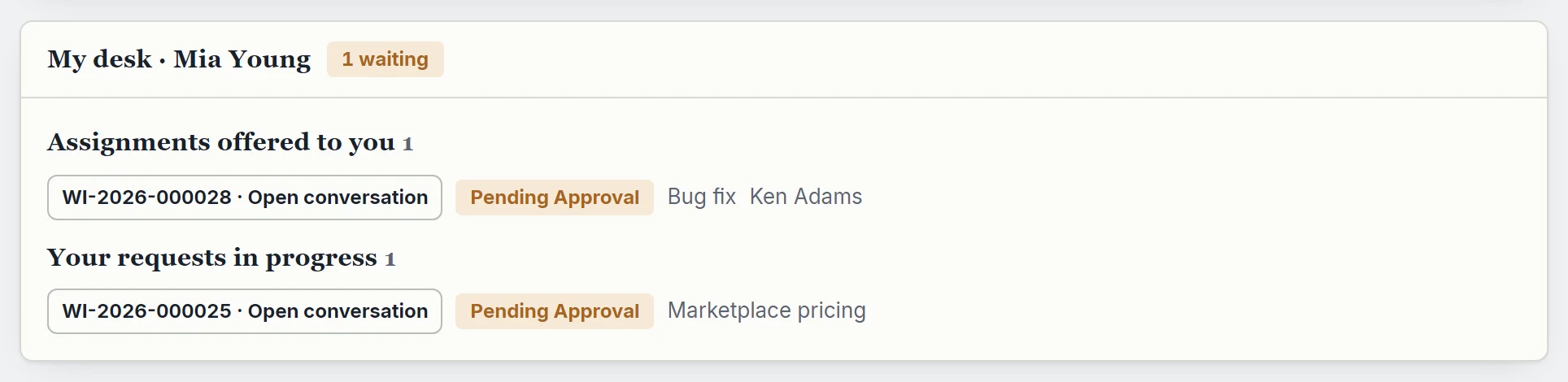
Start a routine refund and an escalated CRM closure. One follows the automatic rules; the other waits for the named manager.
Autonomous agent actionRead the order and proposed the small refund, which the rule let through. The CRM closure was a person’s request; the rule sent it to the manager.
Experience this interactive scenario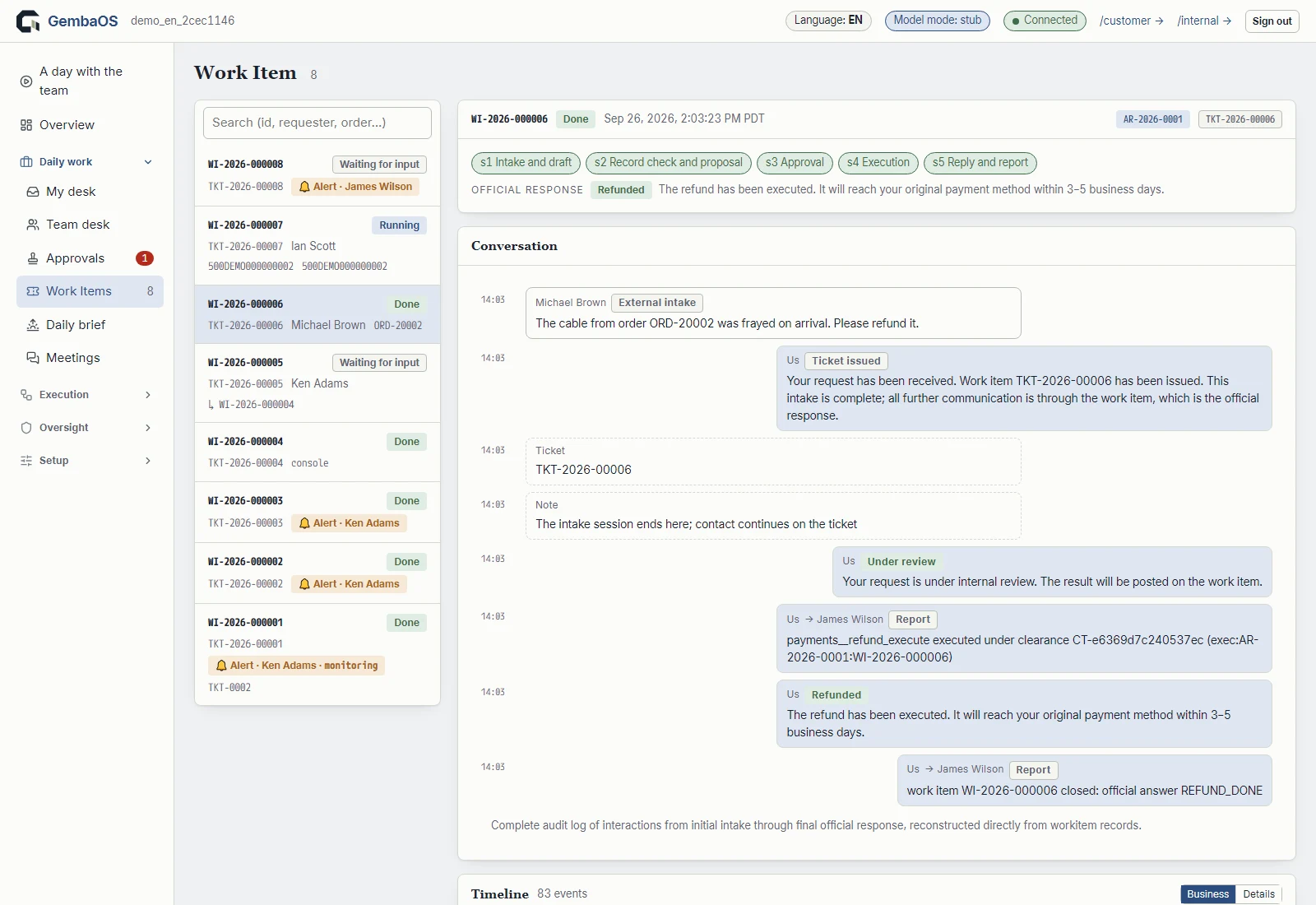
Support Specialist
Type a request in your own words, as an employee would, and send it. In the product an assistant reads it and proposes which business it belongs to, and GembaOS checks the proposal against what you may start and what you wrote; this demo has no language model, so a stand-in picks the business from example words. Change the text and see what happens to a request that fits no business. What comes back is the receipt: the business, the ticket, who holds it and what happens next.
Autonomous agent actionOnly the proposal: the assistant says which business it thinks this is, GembaOS checks it, and no agent starts work until the receipt exists.
Experience this interactive scenario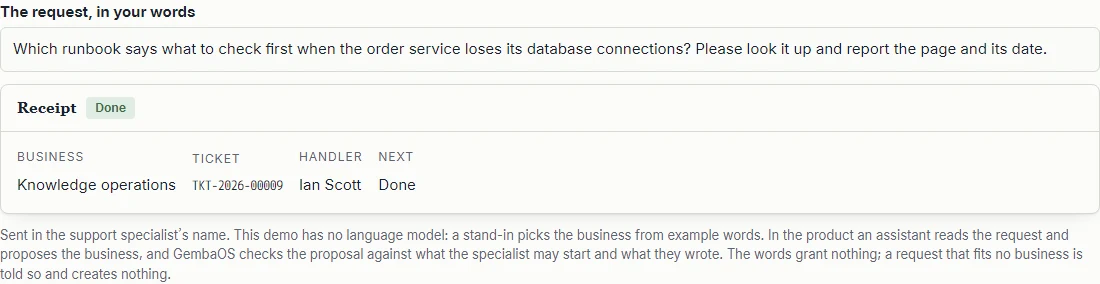
IT Operations Engineer
Return to the same incident and the task assigned this morning. The task remains open for its owner; this public demo does not repair production.
Autonomous agent actionIts morning report is attached to the task. It repairs nothing; the task stays with the engineer.
Experience this interactive scenario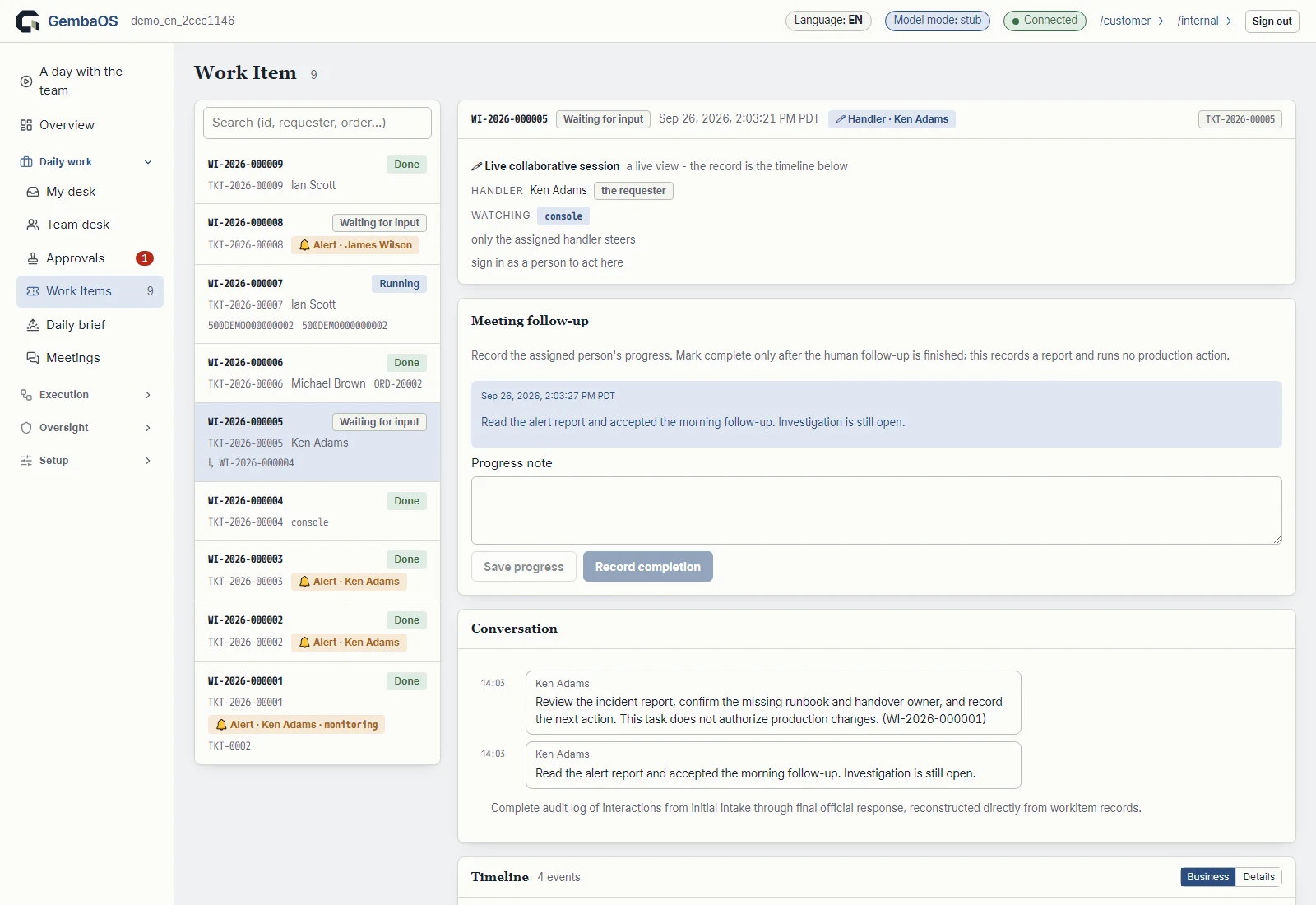
Customer Support Manager
Switch between manager and department head. Only the person in the configured approval route needs to sign; being more senior does not add another signature.
Autonomous agent actionNothing. The signature belongs to the person the route names.
Experience this interactive scenario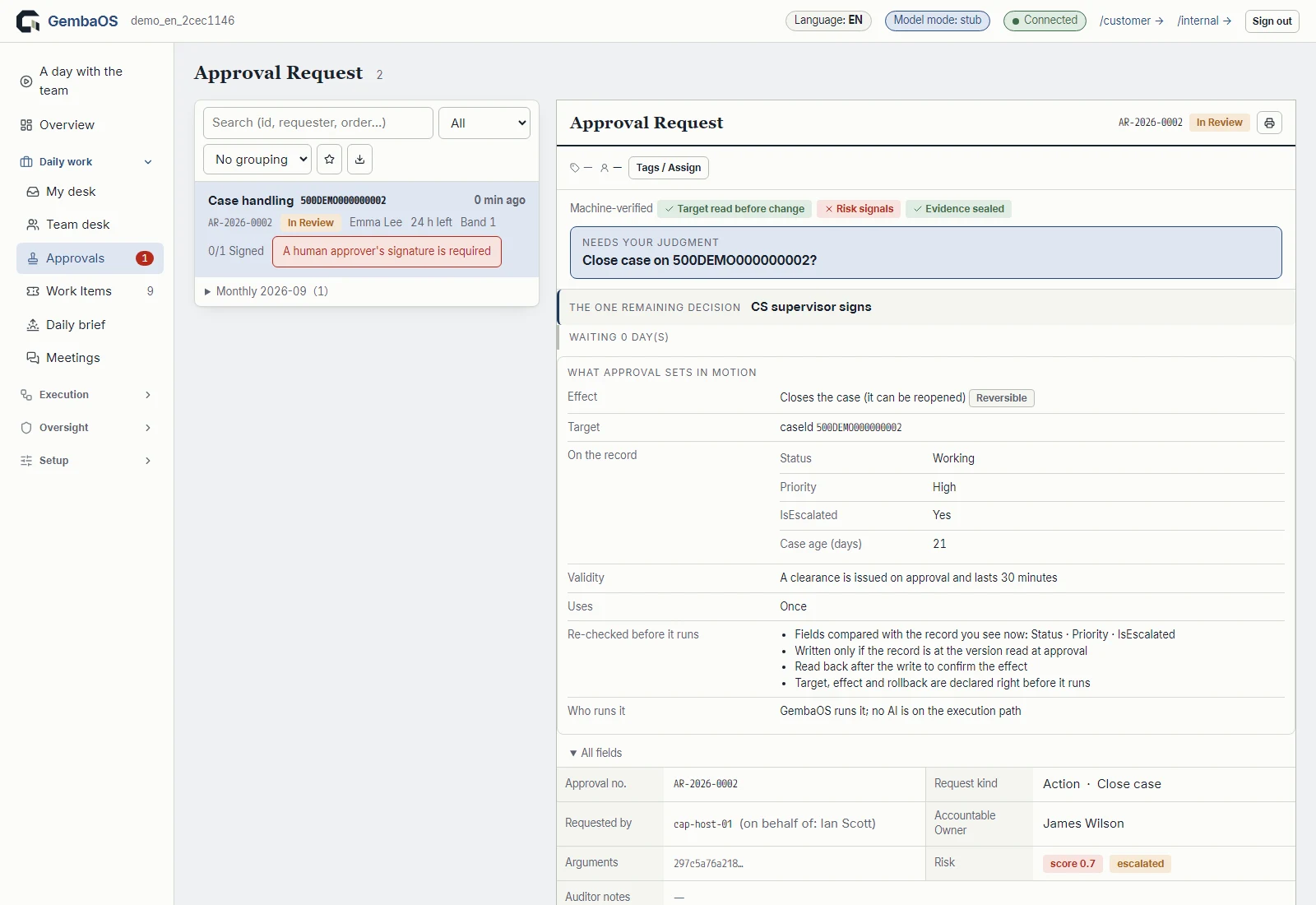
Head of Customer Support
Review the same records: completed requests, remaining decisions and the incident follow-up still assigned to its owner. Nothing resets when the viewpoint changes.
Autonomous agent actionNothing closed on its own. Open items are still with their owners.
Experience this interactive scenario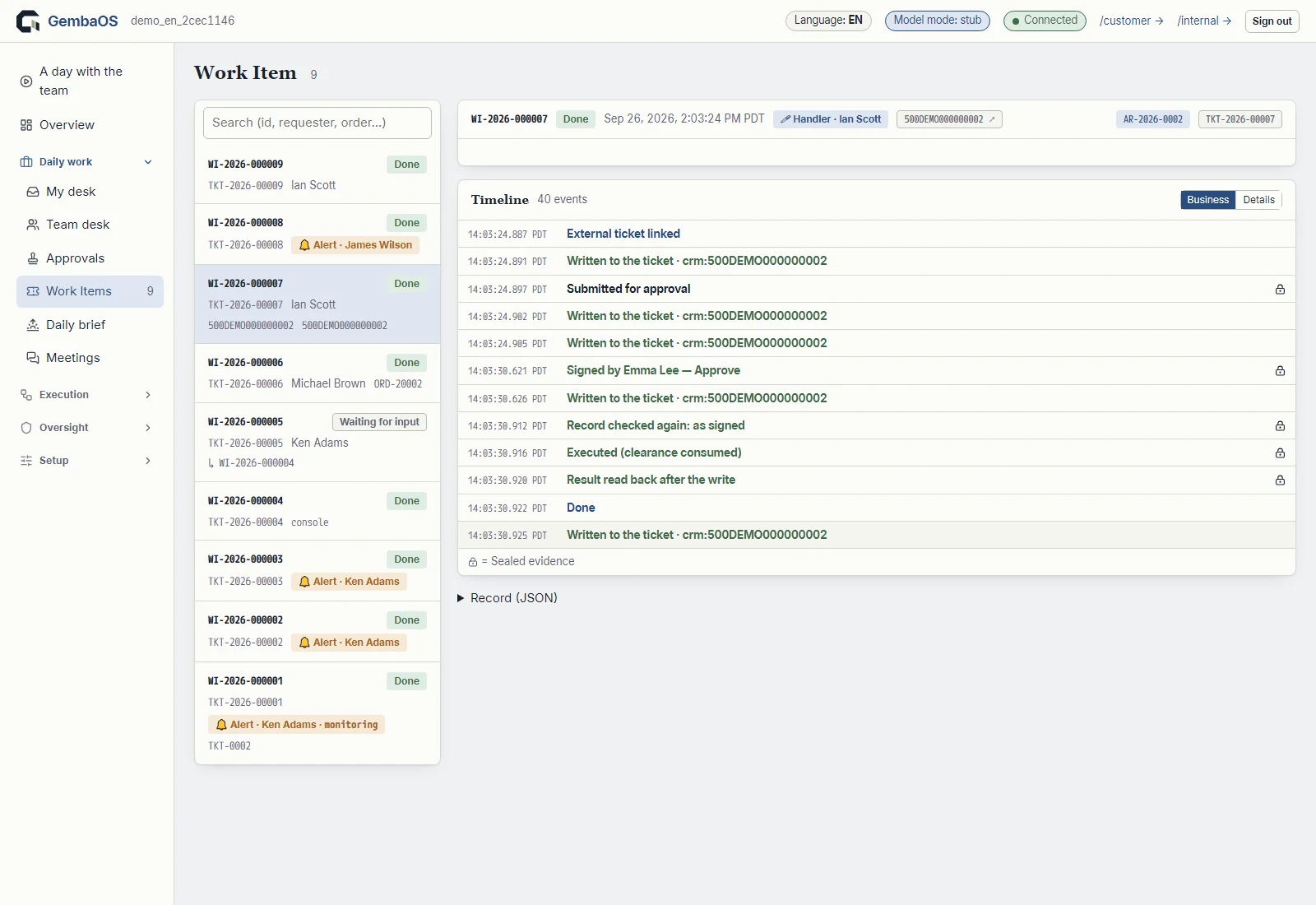
Captured from live demo environment with simulated enterprise data and digital signatures.
04 / TARGETED PILOT PROGRAM
Select one workflow, target systems, business owner, and quantitative success criteria.
Verify data boundaries, authorization logic, and agent actions in shadow mode before expanding automated execution.
Measure reduction in manual touches, approval latency, and unresolved tickets against baseline metrics to justify enterprise rollout.
Pilot scope, timeline, and investment are agreed collaboratively.
05 / ARCHITECTURE & SECURITY REVIEW
Examine private deployment options, model connectivity, system adapter architecture, and underlying security controls.
In-depth look at routing topologies, state diffs, and execution clearance.
Inspect data paths, network isolation, and enterprise governance perimeters.
Review adapter protocols and enterprise connector requirements.
GembaOS is a zero-trust governance runtime for enterprise AI agents: policy-decided access, single-use clearance tokens bound to exact parameters, and accountable human approvals, running on-premises or in a private VPC.
Low-risk reads and operations within configured limits can pass automatically. Only actions that require approval under your policy go to a human, such as above-limit refunds or privileged production changes.
Yes. The Gap Register records missing procedures or ambiguous boundaries. Agents can draft proposed instructions; a responsible human reviews and approves them before they become operational policy.
GembaOS can run on-premises or in a private VPC with self-hosted models. Cloud models and external integrations create their own data paths; configure these deliberately, including gateway-level field scrubbing where appropriate.
Our architects work alongside your team. Plan for an IT or DevOps liaison during setup and named business approvers during shadow mode. The exact effort depends on your integrations and is agreed when scoping the pilot.
LET’S START WITH YOUR WORKFLOW
Tell us which workflows you would like to explore (e.g., finance, ERP, IT operations, or customer support). We will follow up by email to schedule a tailored session.
We reply by email.
Thank you. Your request has reached us and we will reply by email.