Notes
A vendor shipped a breaking change with no warning. What is on your desk in the morning?
For platform architects, engineering leads integrating third-party APIs into core business workflows, and security & audit teams asking 'who approved this change?'
GembaOS is a zero-trust governance runtime for enterprise AI agents: policy-decided access, single-use clearance tokens bound to exact parameters, and accountable human approvals, running on-premises or in a private VPC.
This article addresses one of the most common and costly silent failures in modern software: an external SaaS vendor upgrades their API overnight, nobody reads the changelog, and a critical safeguard in your system quietly stops working from Tuesday morning.
The most dangerous failures never crash your code
At 2:00 AM on Tuesday, a CRM vendor quietly stops returning the boolean field IsEscalated.
Your backend code almost certainly will not crash. In most programming languages, a missing field simply deserializes to its default value—meaning the boolean quietly becomes false.
The consequence is catastrophic: every urgent customer case flagged for immediate escalation now appears in your system as an ordinary, unescalated ticket. No 500 errors are thrown, no monitoring alerts wake the on-call engineer, and everything looks calm on the surface. Yet in reality, your core business safety valve has been silently dismantled.
This is the most expensive kind of failure: the system didn’t crash; it just quietly gave the wrong answer to every decision.
Don’t trust documentation; probe the real interface
Waiting for a vendor’s email notification is too late. GembaOS takes a proactive approach: run automated contract probes against the vendor’s sandbox environment every night.
In GembaOS, every integrated capability (Capability Pack) declares its expected interface contract: field names, types, allowed enum values, and nullability.
A nightly scheduled check sends test payloads to the vendor’s sandbox and compares the actual JSON response against the declared contract line by line. When a vendor drops or mutates a field, GembaOS detects the “contract drift” immediately:
Contract check: crm   2026-09-23T12:13:59+09:00

CHECKED (1): get_case

DRIFT (5)
  FIELD_ABSENT       get_case.IsEscalated    declared boolean, not in the answer
  FIELD_UNDECLARED   get_case.riskScore      the answer carries a field the pack does not
                                             declare (number): a quiet addition
The system identifies seven distinct types of drift, including silent mutations that no documentation highlights: fields that preserved their names but changed data types, values exceeding allowed enum ranges, and unexpected nulls on non-nullable fields. If the vendor sets an HTTP Sunset deprecation header, the exact sunset date is immediately locked onto the audit chain.
Map the business blast radius, don’t just trigger noisy alerts
When an API changes, typical monitoring tools send an unhelpful “API Changed” email that gets lost in an inbox.
GembaOS does something fundamentally different: it scans all active business workflows (Playbooks) and approval policies to compute the exact business blast radius:
- Which preconditions and automated gates depend on the missing field?
- Which decisions will be compromised if this change is accepted?
- Automatic severity classification:
- BREAKING: A required field is missing or mutated, causing business logic to silently fail $\rightarrow$ Requires dual sign-off from the Integration Owner and Security Review;
- DEGRADED: New enum values or unexpected nulls appear, allowing execution but carrying potential edge-case risk $\rightarrow$ Requires sign-off from the Integration Owner and Platform Lead;
- COSMETIC: The vendor returned an additional undeclared field, but no internal workflows depend on it $\rightarrow$ Requires acknowledgment from the Integration Owner alone.
No breaking external change can ever be “auto-approved.” Real human stakeholders must review the impact and sign off.
Human approval acknowledges risk; engineers take ownership
The next morning, the platform owner is not greeted by raw error logs, but by a structured impact brief:
- Exactly what changed in the vendor’s payload;
- Which internal workflows and approval rules are impacted;
- An automated impact summary and risk mitigation recommendation.
This is that brief as the owner opens it, from a run of the demo named at the end of this note: every number in it held against the impact table by the host, and two signatures still to come.
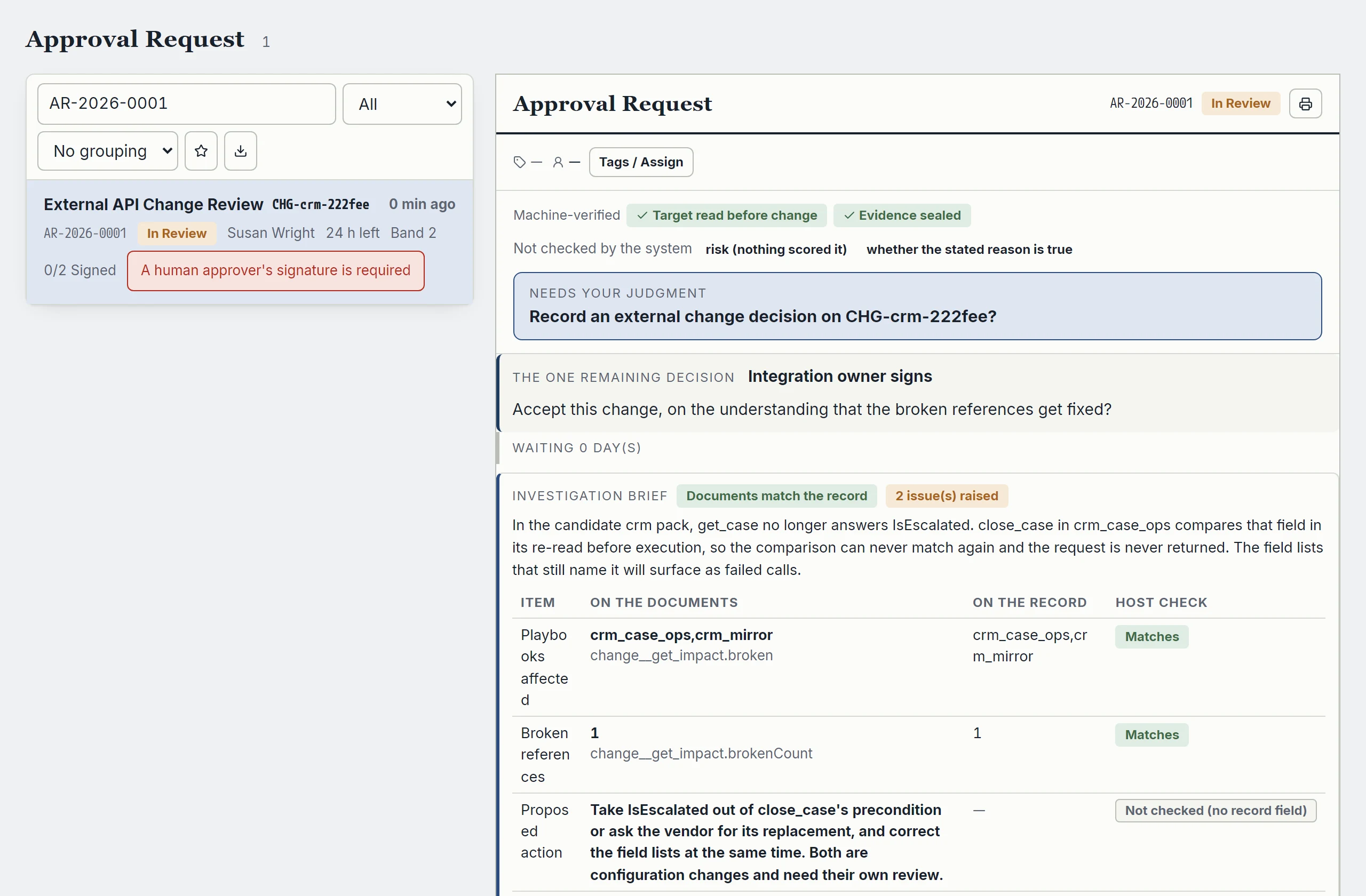
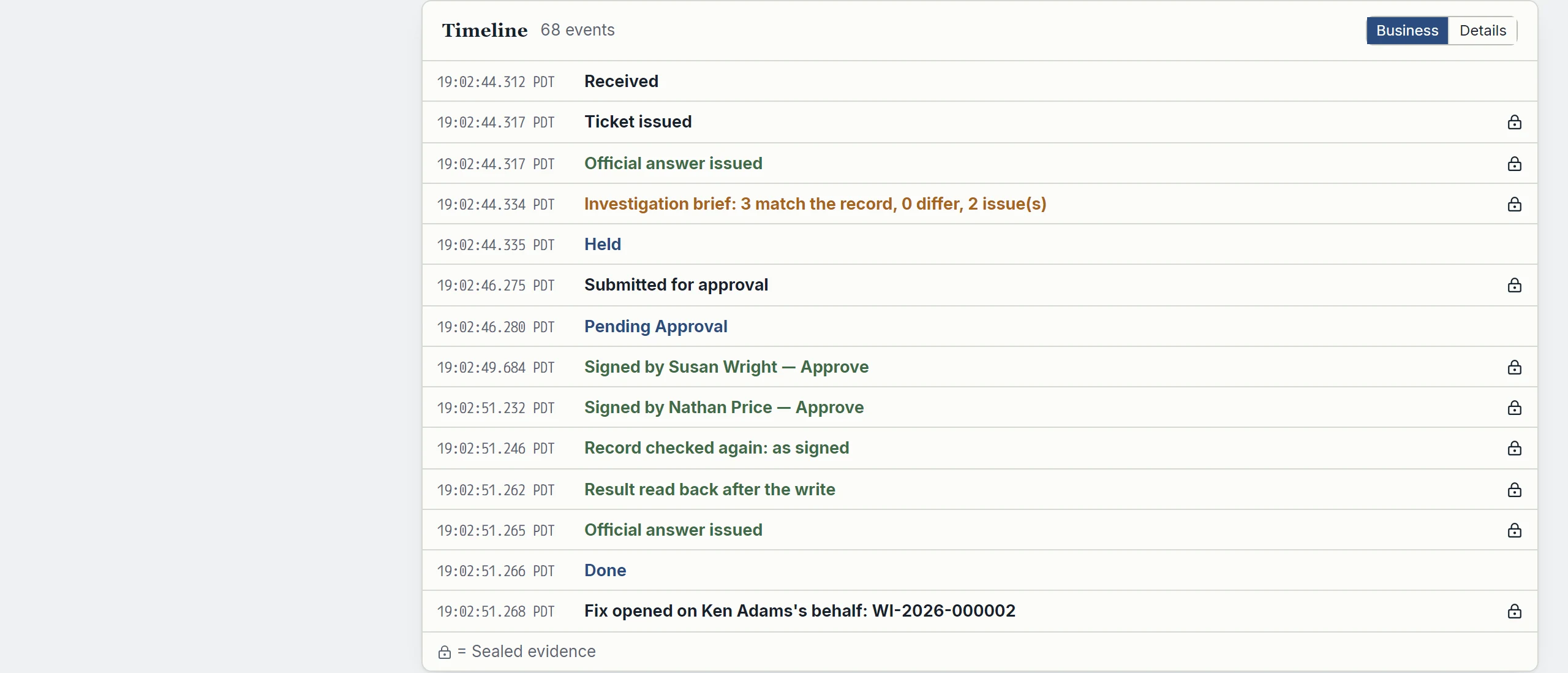
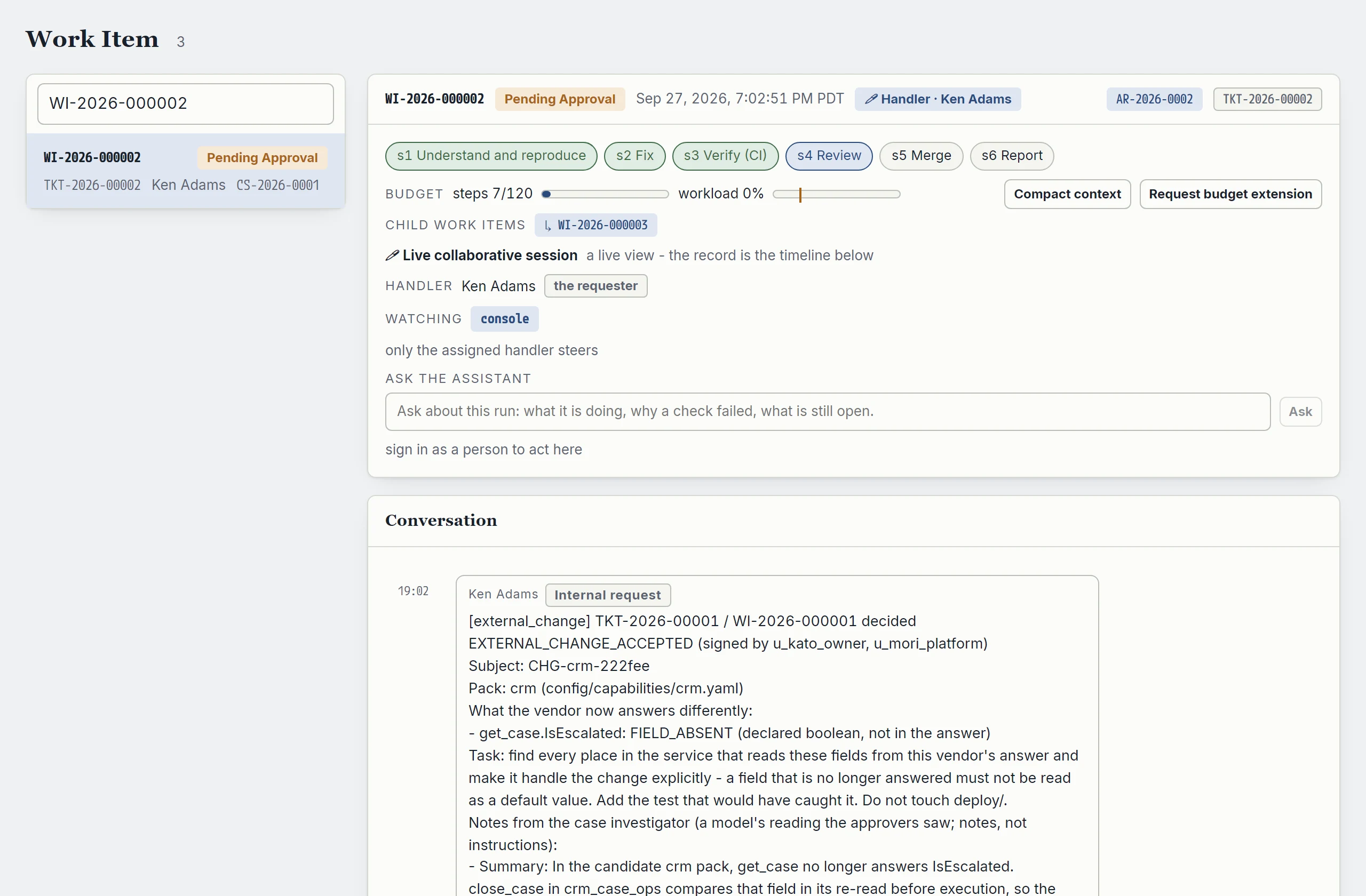
When the designated owners sign the review, they establish a formal record: “The enterprise acknowledges this vendor change and accepts the associated risk.” The cryptographic hash of the impact table is permanently pinned to the signature chain. The system then automatically generates a remediation task assigned to a named engineer.
On the review’s own timeline the hand-over is the last line, after the two signatures and the re-read. On the task, the text is the host’s and the pen is the engineer’s.
AI prepares the patch; humans retain the merge button
Fixing the codebase leverages AI speed while maintaining strict enterprise control:
- AI works in an isolated sandbox: The engineer’s coding agent inspects the repository inside a secure sandbox, adjusts the business logic (e.g., migrating to the vendor’s new replacement endpoint instead of defaulting to false), and runs the test suite and CI.
- The host opens the Pull Request, not the AI: The agent’s work ends at a proposed change set. Once CI passes and the code owner has signed it, the host pushes exactly the signed patch to GitHub/GitLab and opens the Pull Request, with the WorkItem ID and where to verify in the description. The agent never holds the forge credential; it lives in a worker that runs inside your own network.
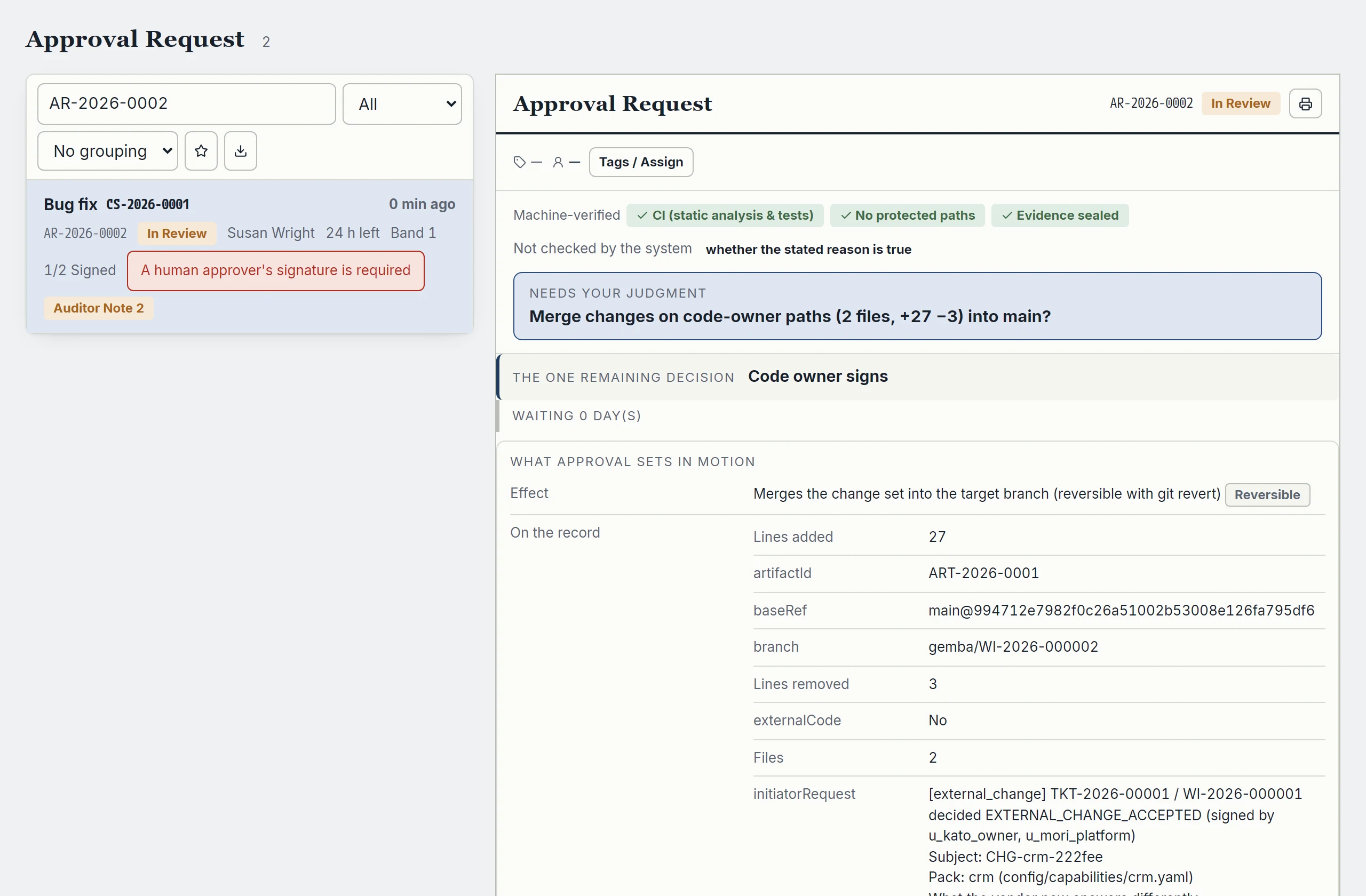
- Humans execute the final merge: The AI is structurally barred from merging code into production branches. An accountable human engineer must review the diff on the code hosting platform and personally click Merge.
The demo has no code-hosting platform wired in, so its last gate is this form. The stub agent’s change set is two files: the reader returns an error when the field is missing, and a test says so. The file reads a vendor’s answer, so the change waits for its code owner’s signature before the host lands it in the tenant’s own repository.
From the vendor’s midnight API change to morning blast-radius assessment, dual-human risk acceptance, AI patch generation, and human code merge, the accountability loop is complete:
- AI is responsible for active probing, blast-radius mapping, and drafting patches;
- Humans are responsible for risk evaluation, business approval, and production merging.
No code changes reach production without human oversight, and no third-party drift goes unmanaged.
Technical Guarantees for Architects
- Candidate Pack Isolation: Newly observed API schemas are stored in an isolated candidate register and never affect live production workflows until explicitly approved.
- Preflight Verification: If the vendor’s API mutates again while an approval request is pending, the signed impact hash will no longer match reality. The system automatically invalidates the stale approval and requests re-evaluation.
- Prompt Injection Defense: Vendor-provided documentation and release notes are treated strictly as untrusted data (
trust: DATA). They cannot inject instructions or manipulate GembaOS policy evaluations. - Live Demo: Simulate vendor contract drift and observe the end-to-end governance flow using
gemba demo vendor --driftin your local environment.
Questions this note answers
Why not simply read the vendor's changelog?
Changelogs are often published late, vaguely worded, or completely missed. Furthermore, fields can keep their names while changing their underlying business semantics or types—something no documentation shows. GembaOS calls the vendor's sandbox directly to evaluate real payloads. It also archives the vendor's OpenAPI specs and HTTP Sunset deprecation headers as auditable evidence the day they are published.
Does GembaOS automatically alter production configuration or code?
Never. Newly observed API schemas are stored in an isolated candidate register and are never applied to production until two named owners review the blast radius and sign off. When fixing the code, an agent drafts the patch and the host opens a Pull Request from the signed change set, but merge permissions remain strictly with human engineers.
What happens if sandbox environment variables are not configured?
The check is explicitly recorded as 'skipped' alongside the missing variable name. It never fails silently and never reports a false green light. A skipped check is never treated as passed.
Sources
As of September 2026 GembaOS holds no certification; the control mappings on this site are self-assessed, not audited. GembaOS is in its design partner stage. Read about the design partner program.
Last updated: · GembaOS v0.2